
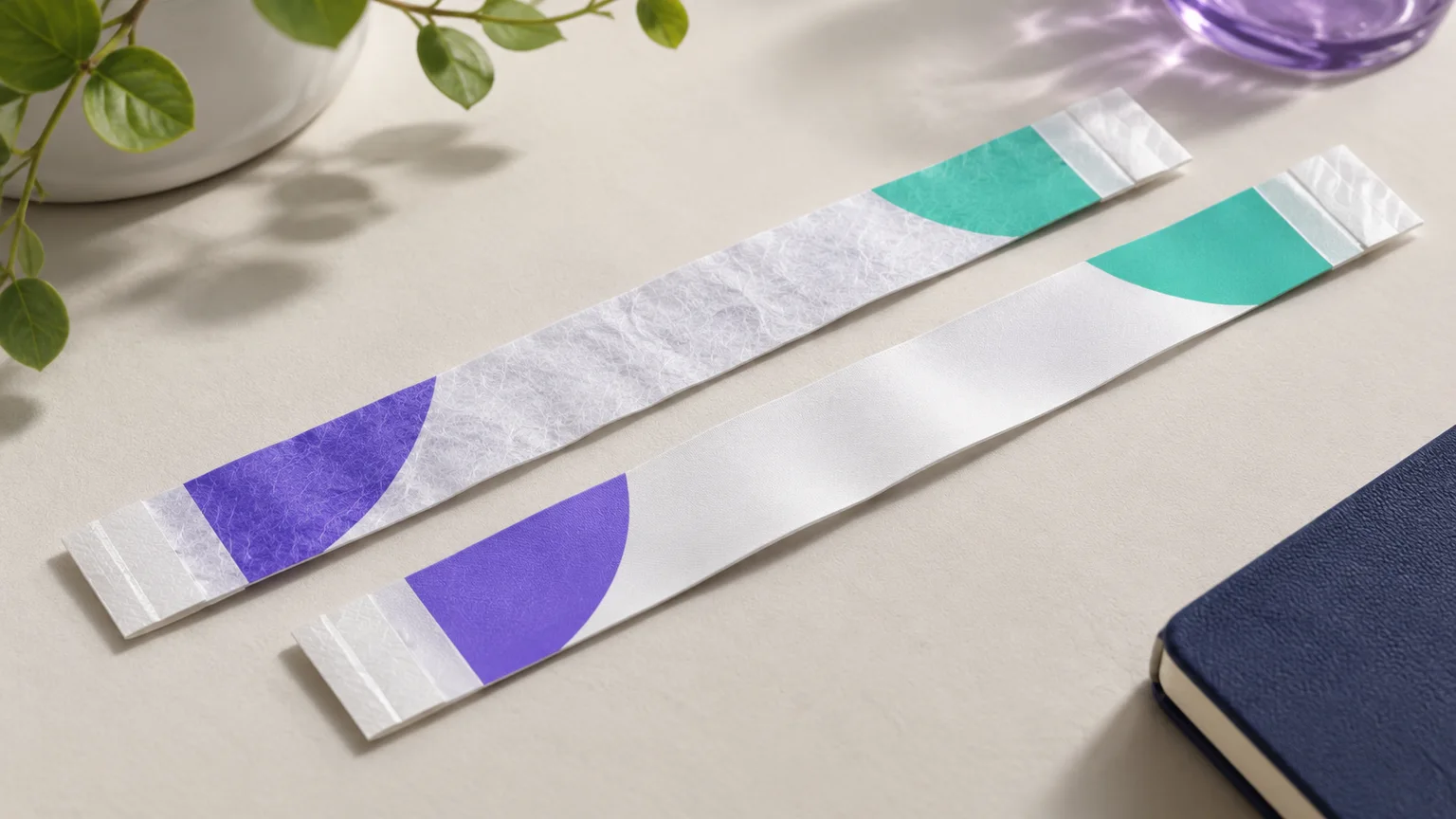
Tyvek is a brand material, not a synonym for paper wristbands
DuPont makes Tyvek from continuous high-density polyethylene (HDPE) fibers bonded into a nonwoven sheet. Nonwoven means the fibers do not form a conventional woven yarn structure. Its lightweight, paperlike appearance can lead people to call it paper, but it is not ordinary cellulose paper.
Tyvek is also a protected brand name. A white tear-resistant disposable band is not necessarily made from Tyvek. If that material is required, identify it in the specification rather than relying on a product photograph or the generic phrase “paper wristband.”
The DuPont material overview describes the fiber structure and distinguishes sheet styles. Properties of a raw grade do not automatically establish the performance of a printed band, adhesive joint or RFID enclosure.
What PP synthetic paper means
PP means polypropylene. Synthetic paper describes a sheet engineered for paperlike handling or printing while using a polymer base. PP stock is not Tyvek, and “synthetic paper” is broader than PP: other polymer constructions also exist.
A PP band can have a smoother, more uniform surface than a visibly fibrous nonwoven. Coatings, fillers, thickness and surface treatment affect the actual finish. Some grades appear matte; others have more sheen. Do not use gloss alone to identify the polymer.
Wristband suppliers may use proprietary names for PP stock. Ask for the underlying substrate and the printing process if comparing differently named products. A commercial product name may describe the finished band without identifying its substrate.
The differences you can see and feel
| Consideration | Tyvek HDPE nonwoven | PP synthetic paper |
|---|---|---|
| Structure | Bonded polyethylene fibers | Polypropylene-based sheet, with grade-dependent treatment |
| Surface | Often a subtle fibrous or irregular paperlike appearance | Often smoother and more uniform |
| Artwork | Depends on the print method and prepared surface | Depends on the coating and print method |
| Folding and handling | Can show characteristic creases in the sheet | Flex and crease behavior depend on thickness and grade |
| Disposable closure | Commonly adhesive overlap with a destructive removal feature | Can also use adhesive overlap and a destructive removal feature |
| RFID | Requires its own integrated or attached tag construction | Also requires a defined tag construction |
Thickness and grade also affect the comparison. A thick PP stock and a thin nonwoven sheet may feel different partly because of their weight and thickness. Compare finished samples when tactile appearance matters.
Printing needs to match the substrate
The artwork result depends on how ink adheres to the selected surface. A supplier may offer spot-color printing, digital full color or variable information on a particular stock. None of those options follows automatically from the words Tyvek or PP.
Check whether the design needs a solid background, gradients, fine lines, numbering or a QR code. Review small text and scannable codes at the finished width. A high-resolution screen file cannot compensate for poor contrast, folds or a code hidden in the overlap.
Polyester dye sublimation is a different process. Do not send the printed fabric settings as if they were a Tyvek or PP production template. Artwork dimensions, printable zones and adhesive coverage belong to the selected disposable construction.
The closure determines single-use behavior
An adhesive band wraps around the wrist and closes at an overlap. Many event products use cuts or other destructive features so removal damages the closure area. Their effectiveness depends on the actual design, bond and fitting.
A water-resistant sheet does not make the adhesive equally resistant to every exposure. Clean handling and the correct overlap matter. A loose fit can allow a band to slide off; an excessively tight fit is uncomfortable. Follow the finished product’s fitting instructions.
Do not describe either substrate as impossible to tear or transfer. Security is a property of the finished closure and the operating process. Single-use and reusable RFID structures explains why the material name is only part of that decision.
Adding RFID without changing the material identity
An RFID inlay combines a chip and antenna on a supporting substrate. It can be incorporated into a disposable band, with suitable protection and placement. The visible strip remains Tyvek or PP; the electronics are a separate assembly within it.
Bending or cutting through the antenna can stop communication. Keep the intended inlay zone and adhesive area distinct from the principal artwork. The presence of a chip does not establish water resistance or compatibility with an admission system.
BandWove’s disposable RFID product keeps Tyvek and PP variants separate. Each uses its own dimensions and artwork zones. They are not interchangeable canvases merely because both products close with adhesive.
Choosing for a one-day event
For basic admission, compare the legibility of the printed group or date, fitting speed, closure behavior and comfort. For electronic admission, also confirm the credential specification and reader workflow. A low-cost visual identifier and an RFID credential solve different operational needs.
If a design requires full-color artwork or individually printed information, confirm that capability on the exact stock. If wet handling is expected, assess the complete band, including adhesive and inlay protection; see the water-resistance guide.
Neither material is always the cheaper or longer-lasting option. Quantity, print method, variable data, inlay and finishing influence cost. Nor does a plastic-based substrate automatically make a used RFID band suitable for a local recycling stream: ink, adhesive and electronics complicate collection.
Can I substitute PP for Tyvek without changing the artwork?
The visible design may be reusable, but the production layout needs checking. Dimensions, overlap, printable area and inlay position can differ. Retain the editable master and adapt it to the selected variant rather than stretching a flattened preview.
Sources & scope
DuPont identifies the Tyvek substrate. Supplier references illustrate converted wristbands; grade-specific properties are not transferred between materials.
- DuPont: what Tyvek is
- RFID GENERAL: polypropylene paper construction and adhesive closure
- Sihl: synthetic wristband media and print-dependent constructions
References checked November 5, 2026.