
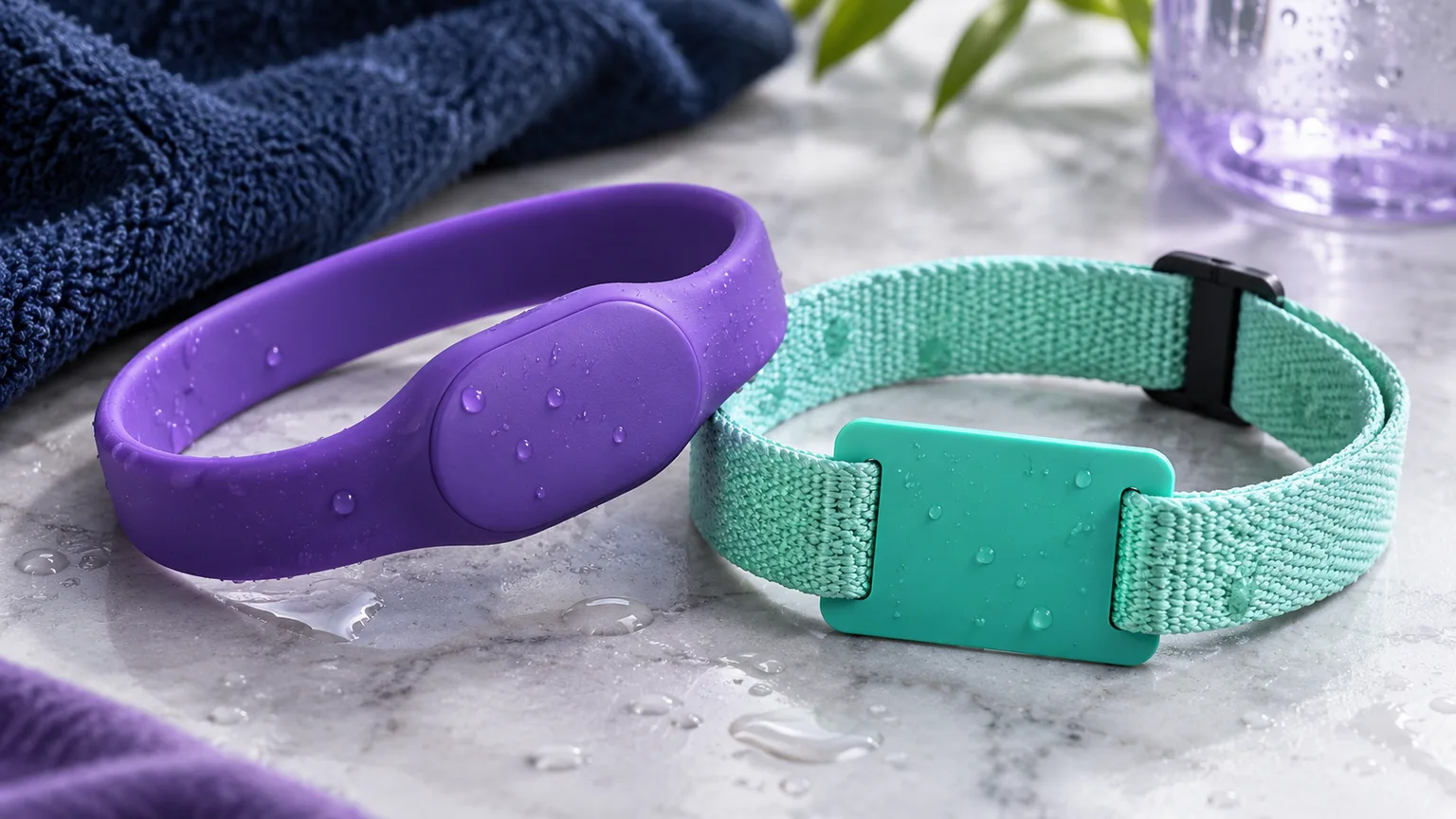
Which part needs protection?
A passive RFID tag contains a chip and antenna with an electrical connection between them. Water, repeated flexing or damage to the surrounding construction can affect that connection. Encapsulation protects the electronics by enclosing or embedding them in a suitable material.
The wearable strap has a separate job. Fabric may become wet while a sealed tag remains protected. A silicone body can resist water yet still have a weak seam around an insert. An adhesive closure can lift even if the chip continues to respond.
Check what the water claim covers: the complete wristband, only the tag housing or only the raw material. A claim for an IC or enclosure is not automatically evidence for every finished band that uses it.
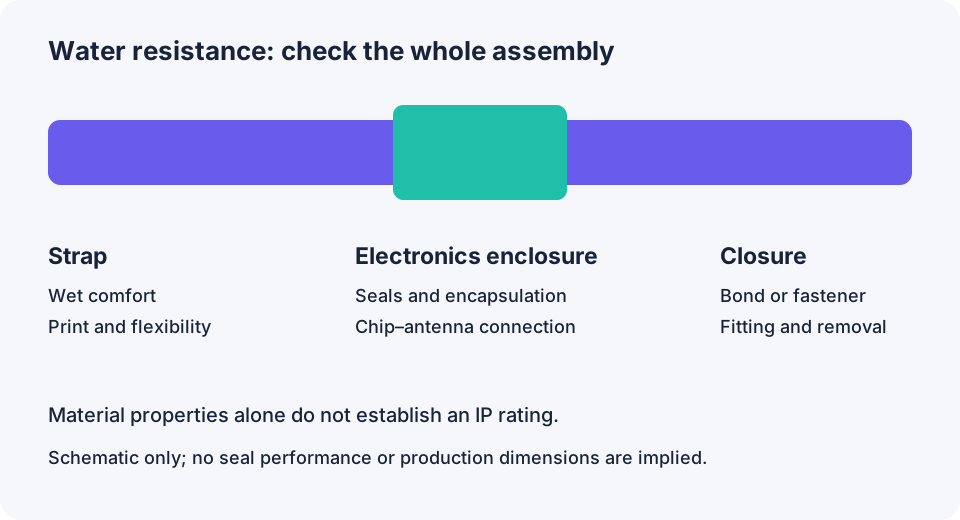
Material gives clues, not a complete rating
| Construction | What to consider in wet use |
|---|---|
| Molded silicone | Electronics encapsulation, molded joints, cleaning chemicals and the exact assembly |
| Printed fabric with separate tag | Whether the tag is sealed, fabric drying and comfort, slider function and repeated flexing |
| Elastic textile with enclosed pocket | Protection of the electronics inside the pocket; a sewn cover is not inherently a watertight enclosure |
| Adhesive disposable band | Substrate, print, adhesive bond, overlap condition and protection of the integrated inlay |
Silicone RFID wristbands are often considered for pools and leisure facilities because the wearable surface is easy to wipe and does not behave like an absorbent fabric. The specific assembly and cleaning instructions still determine suitability. Silicone alone is not an IP rating.
DuPont describes Tyvek as a water-resistant HDPE nonwoven. That explains the substrate, not an RFID band’s adhesive strength, electronics seal or immersion endurance. PP synthetic stock also needs its own finished-product assessment. The Tyvek and PP comparison separates those materials.
Sweat, rain, showers and swimming are different exposures
Sweat and occasional splashes involve moisture, salts and contact over time. Check skin comfort, print rubbing and closure condition as well as whether the tag reads.
Swimming adds sustained water exposure and movement. Pools introduce treatment chemicals; seawater adds salt. A band intended for pool use should be evaluated as a complete assembly in the intended conditions. Drying the strap after a swim does not undo a failed seal.
Showers add warm water, soap and directed spray. An immersion statement does not automatically establish resistance to hot jets or cleaning products. A band that tolerates a brief cool-water dip may have different limits in a shower.
Saunas and hot tubs introduce elevated temperature and other stresses. They require an explicit suitability statement. Do not extend a general “waterproof” description to those environments.
If you already have a venue-issued band, follow that operator’s instructions. Do not test it by immersing or heating it. Ask for replacement if the enclosure splits, the adhesive lifts or the band becomes uncomfortable.
What an IP rating actually tells you
An ingress protection (IP) code describes enclosure protection under defined tests. In a code such as IP67, the first digit addresses solid-particle ingress and the second addresses water. An X indicates that a digit is not specified; it is not a zero.
Water numerals distinguish exposures such as splashing, jets and immersion. IPX7 concerns temporary immersion; IPX8 concerns immersion under specified conditions. The exact test conditions and the rated assembly matter. Do not read “8” as unlimited depth, unlimited time or resistance to every liquid.
The Sennheiser explanation of IP ratings distinguishes water exposures and explains the limits of controlled enclosure tests. Follow the complete stated code and intended-use instructions rather than assuming that an immersion claim covers every spray condition. IP also does not describe the effect of chlorine, soap, abrasion or repeated bending over a service life.
A useful specification names the wristband model, complete rated assembly, test basis and conditions. None of the material comparisons in this article assigns an IP rating to a BandWove product.
Wet use can affect reading without causing damage
Reading performance and water ingress are separate questions. The surrounding water, a wet wrist, the antenna design and presentation to the reader can affect radio coupling. A tag may therefore need a different presentation while wet even when its enclosure remains intact.
Check the actual entrance or locker reader with the intended band on the wrist in representative conditions. A successful scan of a loose dry tag on a desk answers a narrower question. For hotels and leisure facilities, application guidance explains the relationship between the band, reader and credential system.
Questions to settle before choosing a pool wristband
- Is the expected exposure splash, shower, swimming or hot-water use?
- Does the stated protection cover the finished band, including the electronics and closure?
- What water temperature, duration and cleaning products are permitted?
- Will the band be removed, cleaned and reissued, or worn for one visit?
- Has the selected assembly been checked on the intended reader while worn and wet?
For repeated use, the reuse guide also covers inspection and credential reset.
Sources & scope
IP terminology describes enclosure tests. No BandWove assembly rating or service-life claim is assigned here.
- DuPont: Tyvek composition and water resistance
- Sennheiser: IP code digits and limits of enclosure ratings
- IDENTA: different RFID wristband enclosure options
References checked November 5, 2026.