
What is inside the wristband?
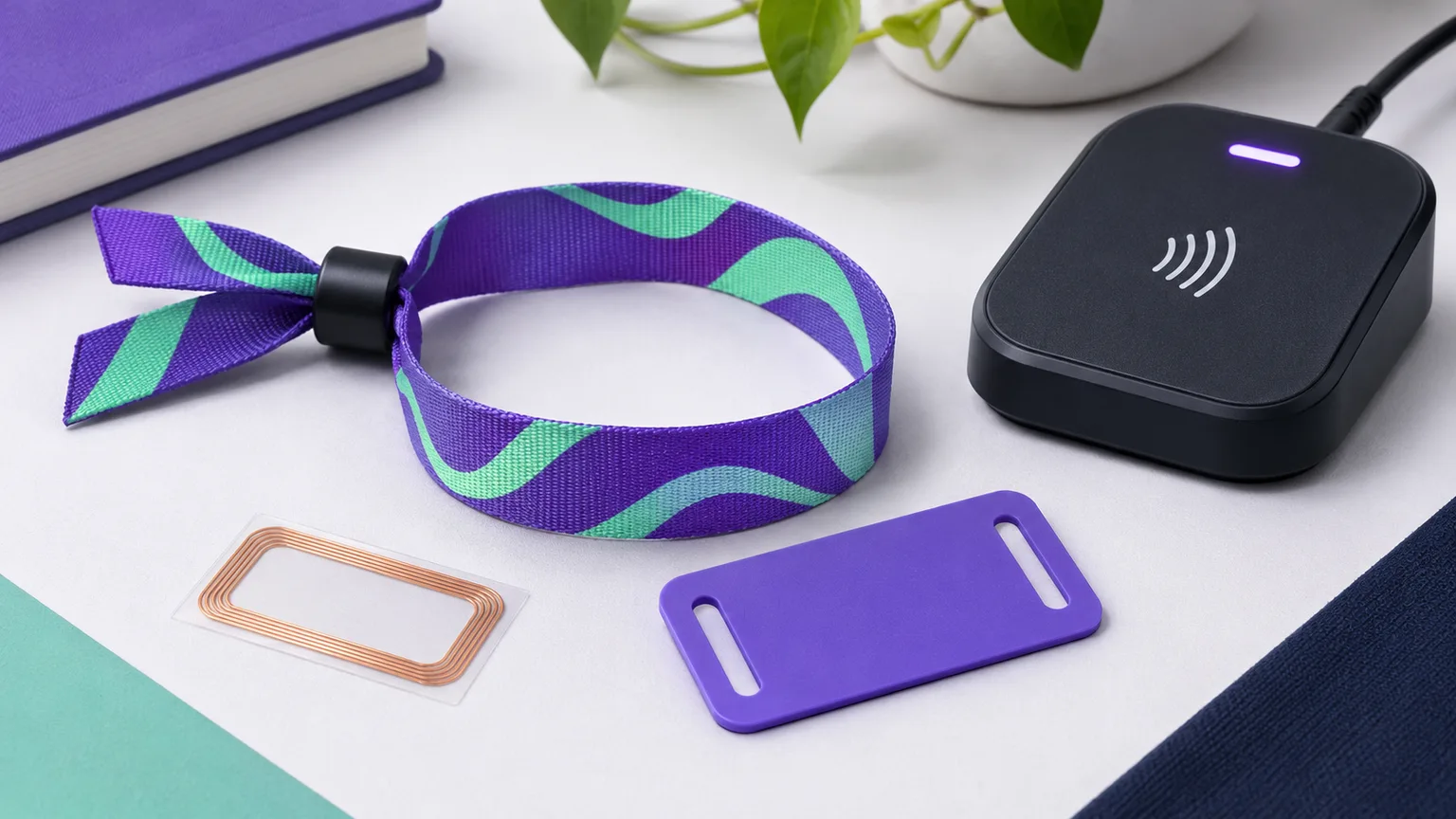
The integrated circuit (IC), usually called the chip, handles the tag’s commands and data. The antenna couples it to the reader. Together they form a tag; an inlay is an assembly of chip and antenna on a supporting substrate before or within its protective construction.
A wristband then provides a wearable body and a way to hold the electronics. A fabric strip may pass through a separate slotted PVC tag. A silicone loop can encapsulate electronics inside the molded body. A disposable band can carry a thin integrated inlay. Those structures explain why the electronic part is obvious in some bands and hidden in others.
A visible card encloses the electronics. Its printed area does not establish reading distance; that depends on the antenna and the reader–tag arrangement.
A scan, step by step
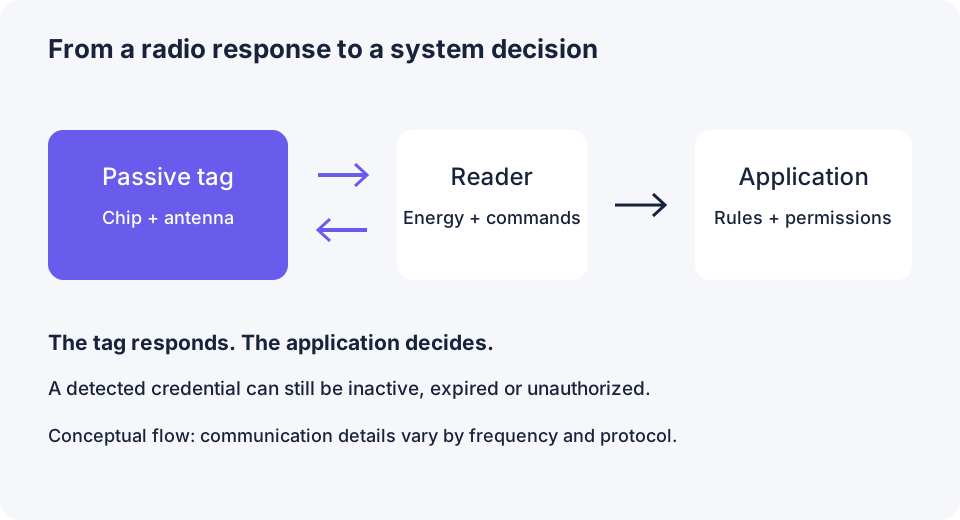
- The reader creates a field. Its antenna establishes the appropriate radio environment for a supported tag.
- The passive tag receives energy. When coupling is sufficient, the chip can operate. The mechanism and communication method depend on the RFID technology.
- Reader and tag exchange commands. The reader may request an identifier, read accessible memory or perform an authenticated operation.
- Software interprets the result. It looks up an account or credential, checks rules and records the relevant action.
- The system responds. A gate, staff screen or application indicates the outcome. A detected tag can still be rejected by the application.
For common HF wristbands, the reader and tag use near-field magnetic coupling. Do not apply that explanation unchanged to every UHF system, which uses different coupling and communication arrangements. The frequency and protocol are part of the technology choice.
Do RFID wristbands need batteries?
Passive tags do not contain a battery for normal radio operation. The reader supplies the operating energy during the interaction. There is no battery to recharge in a conventional passive credential.
Active RFID tags use their own powered transmitter. Battery-assisted passive tags use a battery for parts of their operation while relying on a reader-driven communication scheme. Those are different device classes, explained in GS1’s passive and active tag guidance.
A battery-free tag can still fail if its antenna, electrical connection or enclosure is damaged. Software can also expire or revoke a credential while the electronics remain readable. An LED, display or tracking feature may have a separate power requirement; do not infer it from the phrase “RFID wristband.”
What information is stored on the chip?
Depending on the IC, a tag may expose an identifier and have memory for user or application data. A UID is a chip identifier. It is different from a name printed on the strap, a QR code or a database account number, even when an operator deliberately links them.
An NFC content band can store an NDEF web address. A managed credential may store protected application records or provide data the system uses to locate a server-side account. The person’s complete ticket history or payment balance does not have to be stored on the band.
Encoding means writing suitable data into the chip. Provisioning is the broader process of preparing the credential for its system: assigning accounts, permissions or keys where required. Registering the band may link it to an attendee. These can happen at different stages.
Writing a number into memory does not establish a secure credential by itself. Security depends on how the system authenticates and validates the data. An identifier should not be assumed to be a secret merely because it is invisible on the outside.
What happens at an event entrance?
An organizer issues the band and associates it with the intended ticket or attendee record. At entry, the reader obtains the required credential response. The admission platform checks validity, access group and rules such as re-entry or anti-passback. Staff see the decision, and the system can log the visit.
The wristband supplies a physical credential. The organizer still needs readers, software and an operational process. A printed VIP color helps staff recognize a group visually, but digital VIP rights must also exist in the system if electronic checks are required.
Event and festival applications explain how wearing duration, closure policy and attendee groups affect the choice of band. A one-way closure addresses removal or transfer; it does not replace electronic authentication.
Why a scan sometimes fails
A complete failure to detect can come from a different frequency, an unsupported protocol, poor alignment, nearby metal or damaged electronics. A successful detection followed by rejection points to another layer: permissions, activation, data format or application state.
Keep the band near the documented reading position and avoid presenting several tags at once. If the issuer’s reader fails repeatedly, ask staff to inspect or replace the credential. If only a phone fails, first check whether the band was intended for phone NFC at all.
Reader distance is not one fixed wristband specification. Antenna dimensions, chip sensitivity, reader power, surroundings and the wearer influence the result. Avoid substituting a chip data-sheet maximum for performance of a finished band on a wrist.
Can a phone act as the reader?
A compatible NFC phone can read supported HF tags and accessible content. It does not supply LF or UHF radio capability through an app. Reading an identifier also does not create a valid phone ticket or room key. The phone compatibility guide separates those outcomes.
For the technology families, read RFID vs NFC wristbands. For a particular installation, the accepted credential specification is the starting point; the wristband’s material can then be selected around the wearing requirements.
Sources & scope
The operating diagram separates tag communication from application decisions; it is not an installation schematic.
- GS1: passive, active and battery-assisted tags
- Zebra: RFID tag components and operation
- ID&C: wristband components and reader applications
References checked November 5, 2026.