
What the names tell you
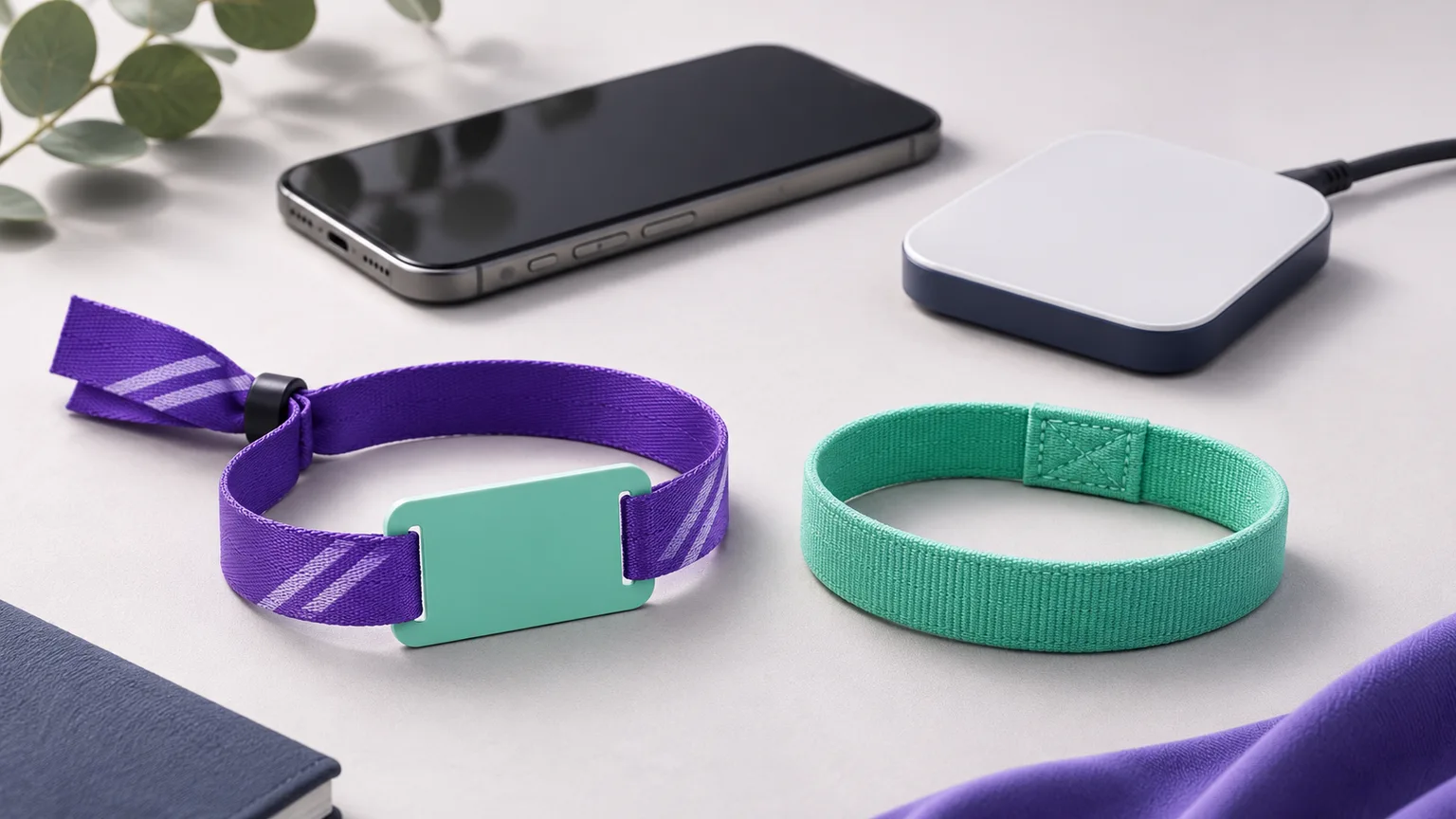
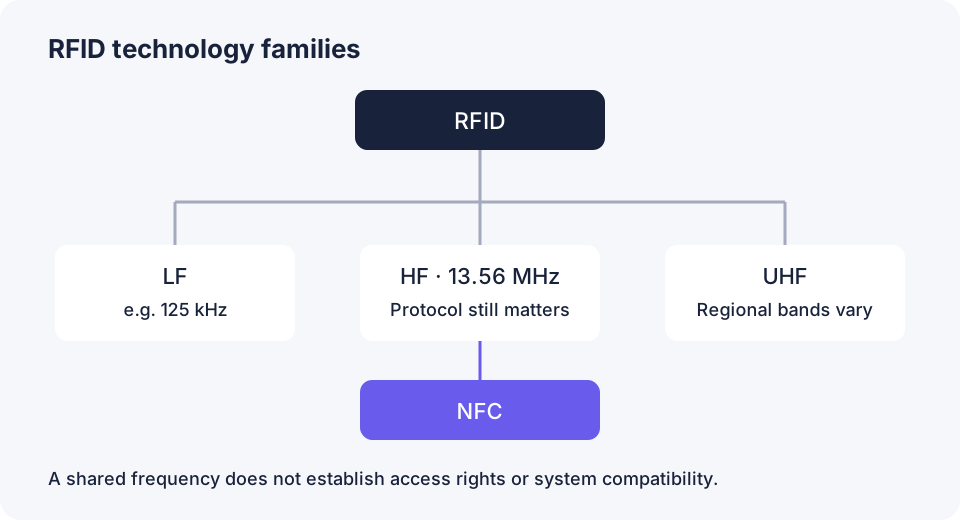
Radio-frequency identification, or RFID, identifies a tag by exchanging radio signals with a reader. The term covers several frequency families and protocols. A wristband holds the tag against the wearer; its fabric or silicone body does not determine the radio technology.
Near Field Communication, or NFC, operates at 13.56 MHz and defines interoperable ways for compatible devices to communicate at close range. In a promotional wristband, the familiar interaction is a phone reading a web address. NFC also supports other operating modes, but buying an NFC tag does not provide those applications automatically.
The NFC Forum’s technology overview explains reader/writer mode, card emulation and NFC tag types. A phone reading a wristband uses reader/writer capabilities. Card emulation is a different role: the device acts as a credential to another reader.
The differences that matter in a wristband
| Question | RFID wristbands generally | NFC-compatible wristbands |
|---|---|---|
| Frequency | May use LF, HF or UHF, depending on the tag | 13.56 MHz |
| Reader | Must match the tag’s frequency and protocol | A compatible NFC phone or dedicated reader |
| Reading distance | Varies substantially with technology, antenna and installation | Intended for close-range interaction; no universal wristband distance |
| Information | May be an identifier or application data | May contain public NDEF content or application-specific data |
| Typical purpose | Admission, identification, managed access or other supported uses | Phone content taps and compatible managed contactless systems |
| Security | Depends on the IC, protocol and system design | Also depends on the IC, protocol and system design |
HF means high frequency. UHF means ultra-high frequency; many UHF RFID systems operate around 860–960 MHz under regional rules. An ordinary phone’s NFC antenna does not become a UHF reader through an app. LF, or low frequency, also requires appropriate reader hardware.
Do not compare a supplier’s maximum UHF read range with an NFC phone tap as though they were interchangeable product settings. Each describes a different radio system. A finished wristband’s antenna, the wearer’s body and the reader position also influence performance.
Why 13.56 MHz alone is not enough
Two products can share a frequency but use different commands, tag types or protected data layouts. Even when a reader can communicate with the chip, its software may not understand the credential. Access to protected data may require authentication and authorized keys.
For example, NXP’s NTAG213/215/216 family implements NFC Forum Type 2 tags. A suitable NDEF message can hold a public link. Other IC families support different memory and security functions. These features belong to the chip and its application; they cannot be inferred from a contactless symbol on the band.
A venue may accept a particular credential family and encoding scheme. Substituting another 13.56 MHz IC can therefore fail even if both products are described as HF RFID. The chip-selection guide addresses that system-led decision.
Phone taps and venue transactions use different workflows
A link to event content
A phone reads an accessible NFC Data Exchange Format (NDEF) record, then opens or offers the encoded destination. The web page handles registration, content or another online action. The tag supplies the link; the website supplies the service.
The link can point to a destination whose content changes later. That does not mean the tag itself has been rewritten. If you need to change the stored address, the tag must remain writable and the writing method must support it.
An admission credential
The reader passes information into an admission system. That system decides whether the credential is issued, active and allowed at the entrance. Anti-passback rules, re-entry and staff permissions are application functions. They are not created simply by printing different colors on the wristband.
Cashless use
A compatible closed-loop event system can associate a credential with an account or balance. It needs readers, software, provisioning and operating controls. A URL tag is not a bank-payment credential, and a passive wristband is not a complete payment platform.
Choosing between the descriptions
For a phone-led campaign, specify the action first: open a mobile page, display information or use an authorized app. Then choose a supported NFC tag type and data format. Test the interaction on the phones your visitors use. Phone-reading guidance explains why some taps produce no notification.
For an installed reader system, begin with the operator’s accepted credential specification. Record the reader model, protocol, chip family and encoding requirements together. Choose the band material separately for comfort, wearing duration and closure needs.
When browsing products, an elastic NFC loop describes a wearable form commonly used for phone interaction. A printed fabric RFID band describes another physical format. Either label still needs an appropriate electronic configuration for the intended use.
Common questions
Is NFC better than RFID?
There is no overall ranking because NFC belongs to the RFID family. NFC suits close-range phone interaction; other RFID technologies serve different reader and distance requirements. Choose for the intended system rather than the name.
Can an RFID wristband become NFC through encoding?
Only if its existing hardware and protocol support the required NFC interaction. Writing a URL cannot change an LF or UHF radio into an NFC tag.
Does NFC mean the data is public?
No. Public NDEF links are one use. Some NFC-compatible credentials contain protected application data. Whether a phone can read that data depends on the chip, application and permissions.
Sources & scope
The frequency comparison concerns technology families. Phone and application support remain device- and protocol-specific.
- NFC Forum: NFC operation, modes and data formats
- NXP: NTAG213/215/216 data sheet
- GS1 US: RFID and NFC relationship
References checked November 5, 2026.