
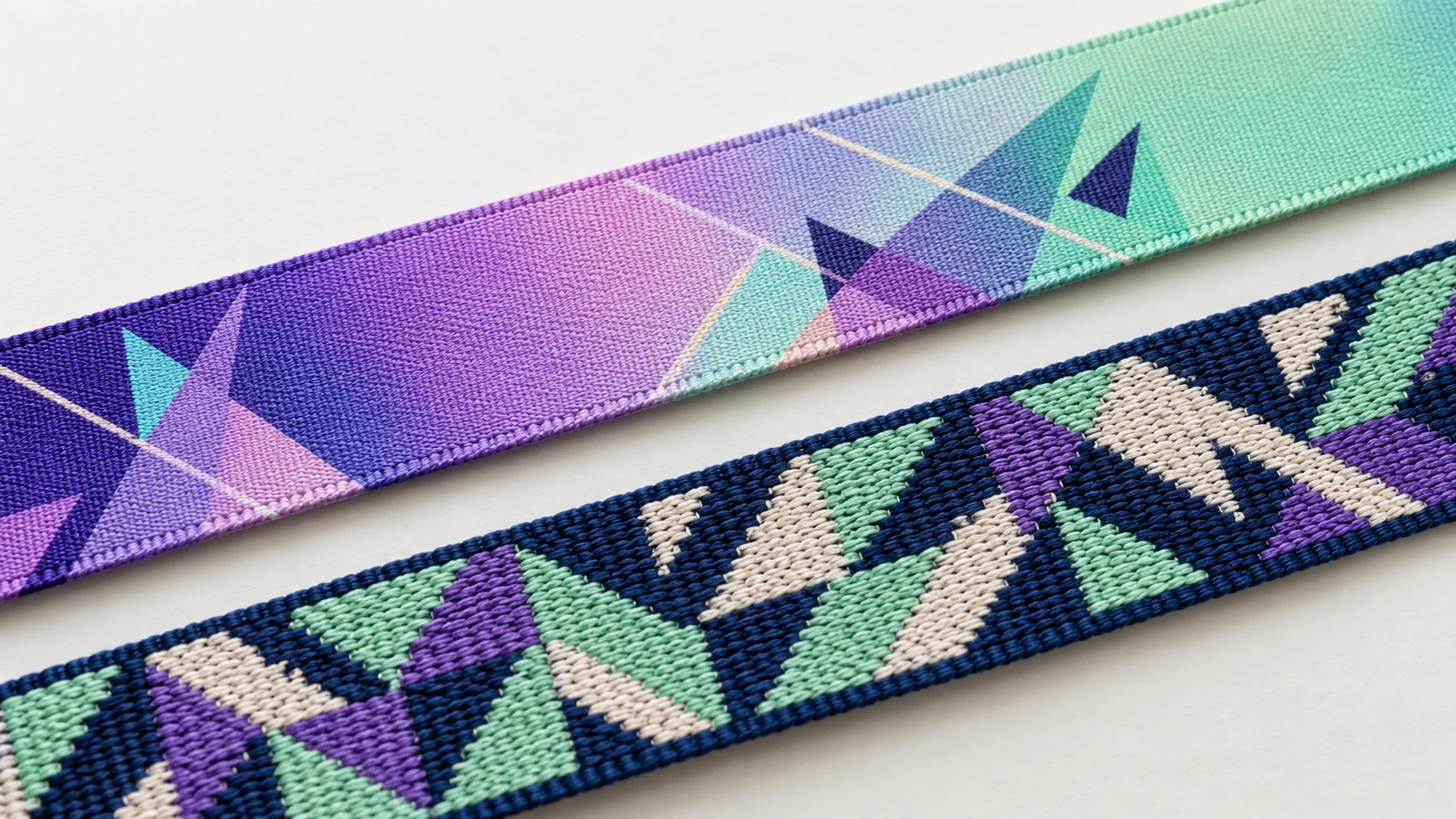
Two ways to form the design
Full-color dye sublimation transfers a printed design into suitable polyester fabric. It accommodates color transitions, shaded illustrations and multicolor patterns without turning every change into a separate yarn choice. The printed surface still has a textile structure; a digital proof does not remove the fabric’s effect on very fine details.
In a woven wristband, the colored yarns form the design during weaving. The artwork must be interpreted as thread-built shapes. Strong lettering, distinct color blocks and simpler repeated motifs suit that structure. A woven layout is not produced by applying a texture filter to a print file.
Match the process to the artwork
| Artwork consideration | Printed fabric | Woven |
|---|---|---|
| Gradients and photographs | Suited to full-color transitions | Rework into discrete yarn-colored shapes |
| Color choices | Full-color artwork; agree critical brand references | A defined yarn palette reviewed for the selected construction |
| Small lettering | Check contrast and detail at finished size | Simplify shapes and review thread-level legibility |
| Surface character | A printed design on the fabric base | The design is part of the yarn structure |
| Back design | Separate artwork; check orientation and registration | Reverse appearance depends on weave construction |
| Current Studio mode | Printed fabric, front/back and tag | Requires separate rules; not a selectable mode |
Public suppliers use different widths, color limits and constructions. We do not apply a single color count or minimum letter size to every woven product. The final weave specification needs its own palette and detail review. A screen drawing alone cannot confirm how a small woven letter will resolve.
Prepare a file for the chosen process
- For printed fabric, retain full-color artwork and original-resolution images. Set up the selected band width before refining the design.
- For woven artwork, separate the intended yarn colors and simplify fine outlines, small gaps and photographic effects. Keep an editable master for the weave-specific interpretation.
- For either process, use repeated branding thoughtfully and leave important messages clear of closure coverage. Review actual-size lettering rather than only a magnified screen view.
- Treat the independent RFID tag as a separate component. Its artwork method and printable geometry do not become the same as the band simply because the band process changes.
Brand color references help communicate intent, but a monitor, dye-sublimated fabric and colored yarn can look different. Review the selected material and proof for color-critical work instead of expecting a screen value to guarantee a physical match.
Keep construction and RFID separate
Printed or woven describes how the band artwork is formed. RFID describes the electronic credential and its integration. Either artwork process still needs a defined tag construction, chip and system requirement. Do not assume a woven band has a different reading capability, or that a printed band works with any reader.
Our current printed fabric configuration uses an independent PVC RFID tag and a black barrel/security slider. Other suppliers may sew an inlay into a woven pocket. Those are different assemblies; do not combine their dimensions, performance statements or artwork rules into one specification.
Start in the right design mode
BandWove Studio currently edits the printed polyester format in 350 × 15 or 20 mm with separate front, back and RFID tag artwork. Use it for the full-color direction, save an editable project and export each surface for review.
For a woven direction, prepare an editable vector reference with clear color blocks and note the process in your project brief. The current Studio does not convert that file into a weave specification or offer a woven design mode. Confirm the weave-specific palette, lettering and reverse appearance separately.
Sources & scope
The references below support the technical and process distinctions in this guide. Supplier constructions and IC properties do not establish BandWove product performance or system compatibility.
- ID&C printed fabric: process comparison
- Nordic embedded RFID/NFC fabric: construction options
- ID&C RFIDXBANDS: printed and woven constructions
References checked October 30, 2026.