

Could you leave Tomorrowland and come back?
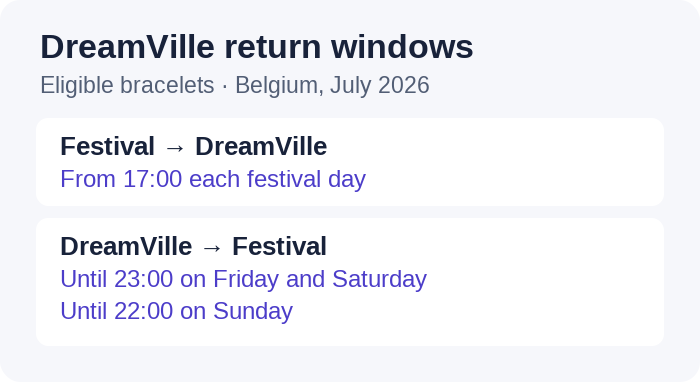
At Tomorrowland Belgium 2026, a Day Pass gave you no return on the same ticket once you left. A standalone Full Madness Pass let you come back the following festival day. If your bracelet included DreamVille access, you could return from the festival to the campsite from 17:00, then cross back before the festival’s two-hour cutoff. For the return to the festival, that meant 23:00 on Friday and Saturday and 22:00 on Sunday, local time. Check the organizer’s opening hours for the edition you’re attending.
Let’s go back to that jacket. If you had DreamVille access and tried to take the internal route from the festival at 16:30, its return window hadn’t opened. At 18:00, you could head to your tent. You could then get back to the festival at 21:30 through the DreamVille route. By 23:20, you’d have missed the cutoff, even though Friday’s program was still running.
The public entrance had another clock. Its check-in closed at 22:00 on Friday and Saturday and 21:00 on Sunday. So if a friend tells you, “You can get in until eleven,” ask which gate they mean. That hour applied to the DreamVille return route on Friday and Saturday. It also says nothing about your campsite check-in on arrival. DreamVille had separate rules for that.
A wristband can scan and the gate can still say no
When you present a bracelet, the reader has a simple job. It picks up a credential the access system can check. The next question is whether that credential is allowed through this gate, in this direction, right now. An RFID (radio-frequency identification) wristband can be readable and still get a refusal. A regular weekend band at the campsite route is a good example. The reader may recognize the credential, while the route requires DreamVille access.
Tomorrowland’s ticketing guidance describes the bracelet’s unique barcode or RFID identifier and the scan at entry. From the guest’s point of view, what matters is that a band linked to a valid ticket can carry different access rights from the one next to it. For an event team, the difference between a failed read and a rule refusal determines where you send the guest. One needs help with a credential. The other may need directions or a quick explanation of the schedule.
We’d also keep the entrance and the bar separate on the operations sheet. A bracelet can be used for admission and cashless payments, with each part of the system making its own decision. A drink purchase going through gives a steward no reason to override a gate refusal.

How we’d turn the re-entry policy into a gate plan
Start with the site map. Draw a separate arrow for each direction people can walk. Give every arrow a line on the gate sheet with the eligible pass, opening window and what the steward should say if a guest is refused. A single row called “camping gate” hides the two decisions that mattered at Tomorrowland.
This example uses the published Friday hours for 2026. The last column suggests wording for a crew briefing.
| Route | Friday check | What a steward can tell a guest |
|---|---|---|
| Public entrance | Public check-in closes at 22:00. Check the ticket and any same-day return restriction. | “Public check-in has closed. If you’re returning from camping, ask a steward for the DreamVille route.” |
| Festival → DreamVille | DreamVille entitlement and a crossing at or after 17:00. | “This route back to camping opens at five. You’ll need a bracelet with DreamVille access.” |
| DreamVille → festival | Eligible bracelet and return by the 23:00 cutoff. | “The last return from camping is at eleven tonight. Allow time to get back to this gate.” |
Next, walk the route with the crew. Where will someone see the return instructions before choosing an exit? Can the person on queue duty give the same answer as the person at the scanner? If a line forms just before closing, decide in advance which point counts as arrival. It could be the reader or a staffed queue checkpoint, depending on the policy. The shift lead should know who can approve an exception and where to move a guest who needs help, so the line can keep moving.
An exit scan is worth discussing when the next entry decision depends on whether the person left. In that case, the system needs a reliable way to record the departure. For a gate that simply closes at 23:00, a timetable rule may be enough. During rehearsal, give the access provider one rule from each category and ask to see what the reader shows when a person exits through the wrong lane or when a scan is missed. Those are the cases a neat diagram tends to hide.
Decide what the steward needs to see
Imagine the same red light for three people. One missed the deadline, one bought the wrong pass for this route, and one is holding a bracelet the reader hasn’t picked up. Each needs a different conversation. Write the short crew instructions before the show and ask the access provider which reasons the device can actually display. If it shows a single refusal message, give the steward a quick way to check the reason or move the guest to a staffed lane. Otherwise a timed cutoff can look like a wave of broken wristbands.
Treat the repeated tap as a separate case. A guest may keep their wrist on the reader, or tap again because the person ahead of them hasn’t moved. Try both during rehearsal. Agree which signal tells a steward that someone was already admitted and what to do when a scan succeeded but the person couldn’t physically pass. The appropriate response depends on what the system recorded and how the lane is laid out.
Where the wristband design can help the crew
Make the bands easy to sort when people collect them. A distinct color with a short printed label gives the desk team a quick way to separate, say, campsite packs from public admission packs. Put that label where it stays visible after the closure is fitted. Get someone to read it under the lighting you’ll actually use. A graphic that works on a flat proof can disappear under the clasp or around the inside of a wrist.
Think about when the band comes off. A fabric band with a one-way closure makes sense to consider when guests are expected to wear the same credential throughout a festival. Pair the choice with a replacement process for a cut, lost or uncomfortable band. If guests need to remove it between visits, decide how you’ll handle transfer or check the holder’s entitlement on return. Before placing an order, have the access provider scan a sample of the finished band, with the chosen tag fitted. The artwork team can approve the look while the gate team checks the fit and how guests present it to the reader. Our guide to printed and woven wristbands covers what each finish does well when you’re deciding how to mark the passes.
One handoff we’d put in writing is the relationship between the printed mark and the electronic credential. A color or a short label helps the crew recognize a group. A printed serial can help the help desk identify an individual band if you’ve set up that lookup. The identifier read at the gate is a separate field. If the ticketing team needs to associate the two, ask how it expects to receive the mapping and who owns it when a band is replaced. Rehearse with a spare from a different carton as well as one from the expected carton. If the spare looks right but carries the wrong entitlement, the crew needs to find that out at the issue desk.
What to rehearse before the first crowd arrives
Run a weekend band with no campsite access through the campsite route and watch the screen. Can the steward tell a valid read with the wrong permission from a band the reader couldn’t pick up? Try both sides of the cutoff with a device set to event time. Then issue a replacement, try it at the gates it should open and check that the original is refused. If two desks can issue replacements, rehearse how the second desk and the gates learn what changed.
If you rely on more than one lane, try the same test with one device disconnected. Ask which rules it can still apply, whether a recently replaced credential is known to it, and how its records catch up when it reconnects. Agree on which guests can be handled locally and which need the help desk while the connection is down. For a wider view of how credential formats affect that plan, see our RFID and QR comparison for event entry.
Finish the walkthrough where the guest makes the choice to leave. If a steward can explain the right return route and cutoff in one sentence at that point, you’ve already handled much of the confusion a reader would otherwise have to sort out later.
Photo credits
Tomorrowland Mainstage · Ludovic Delot · CC BY 4.0 (cropped and resized). https://commons.wikimedia.org/wiki/File:Tomorrowland_2026_Mainstage_Night_Show_Boom_Belgium.jpg · https://creativecommons.org/licenses/by/4.0/
DreamVille · sergejf · CC BY 2.0 (resized). https://commons.wikimedia.org/wiki/File:Tomorrowland_2014_-_Retreat_to_Dreamville_(22567782023).jpg · https://creativecommons.org/licenses/by/2.0/