

However, not all RFID wristbands work with the same equipment.
Different RFID technologies operate at different frequencies and use different communication protocols. A wristband that works with one reader may not be recognized by another, even if both products are described as RFID wristbands.
For event organizers and procurement teams, choosing the right technology starts with understanding the existing reader system and the task the wristband needs to perform.
This guide compares low-frequency (LF), high-frequency (HF/NFC) and ultra-high-frequency (UHF) RFID. It explains how they differ, where each technology is useful and what to confirm before ordering custom RFID wristbands.
Understanding the Main RFID Frequency Types
LF / HF / UHF: start with the reader
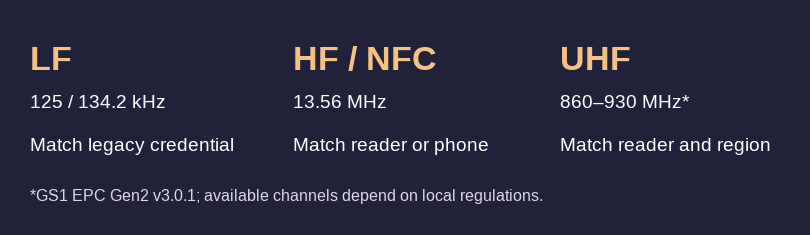
RFID, or Radio Frequency Identification, uses radio waves to exchange information between a reader and an electronic tag. A typical passive RFID wristband contains a chip and an antenna. When the wristband enters the reader’s operating field, the chip responds according to its supported protocol.
The three main RFID frequency groups are LF, HF and UHF.
| Technology | Common frequency | General characteristics | Typical applications |
|---|---|---|---|
| LF RFID | 125 kHz and 134.2 kHz | Short-range identification; established access-control applications | Legacy access systems, identification |
| HF RFID | 13.56 MHz | Contactless communication with several standards and chip families | Event ticketing, access control, NFC interactions |
| UHF RFID | 860–930 MHz in GS1 EPC Gen2 v3.0.1; available channels depend on local regulations | Longer-range identification and multi-tag reading | Inventory, asset tracking and selected high-throughput applications |
These frequency groups are not interchangeable. They also do not describe every aspect of an RFID system.
Frequency determines part of the radio interface, but compatibility also depends on the chip, communication protocol, reader configuration, antenna design and software platform.
For a broader introduction to the relationship between a wristband chip and its reader, see How RFID Wristbands Work.
125 kHz LF RFID for Traditional Access Control
Low-frequency RFID commonly operates at 125 kHz or 134.2 kHz. It has a long history in identification and access-control applications.
A typical LF system uses a reader to energize a nearby passive tag and receive its identification response. Many established systems use relatively simple identification credentials, although the exact capabilities depend on the chip and protocol.
LF RFID may be suitable when an organization already operates a compatible low-frequency access-control system and wants to use wristbands instead of cards or key fobs.
Potential applications include:
- Staff identification in facilities with existing LF readers.
- Basic access control for selected areas.
- Membership or visitor identification.
- Projects where an existing LF credential system needs a wearable format.
What makes LF RFID useful?
LF systems can be appropriate for relatively simple identification tasks. They are also less affected by some types of radio-frequency interference than higher-frequency systems.
However, their read speeds and operating ranges are generally more limited than those of UHF systems. Compatibility between different LF products should never be assumed simply because they share a nominal frequency.
Two 125 kHz products may use different chip technologies, data formats or reader protocols. A reader designed for one credential family may not recognize another.
When should an event organizer consider LF RFID?
Consider LF when the venue already has a documented LF infrastructure and the wristband needs to function as a compatible credential.
Before ordering, obtain the reader model, supported chip type and protocol from the system provider. If these details are unavailable, request technical confirmation and test a sample before approving production.
One additional limitation is worth noting: standard smartphone NFC readers do not operate at 125 kHz. A 125 kHz wristband should not be selected for a project that requires visitors to tap the band with an ordinary NFC-enabled smartphone.
13.56 MHz HF RFID for Contactless Identification and NFC Applications
High-frequency RFID commonly operates at 13.56 MHz. It is widely used in contactless cards, access systems, transport ticketing and event-related applications.
NFC, or Near Field Communication, also operates at 13.56 MHz. It is designed for short-range interactions, such as tapping a phone against a compatible tag or reader.
This makes HF RFID an important technology family for event wristbands.
Common chip families and technologies include:
- NTAG213, NTAG215 and NTAG216.
- MIFARE Classic.
- MIFARE Ultralight.
- MIFARE DESFire.
These products do not all perform the same function. They differ in memory structure, communication protocols, security features and supported applications.
For example, a simple NFC tag may be suitable for opening a web page, while a secure access credential requires a different level of system integration.
Common applications of HF RFID and NFC wristbands
Event ticket validation
A wristband can carry an electronic credential that is associated with a ticket record in the event management system. At an entrance, a compatible reader checks the credential and the system determines whether access should be granted.
Access control
Different credentials can be associated with different permission levels, such as general admission, VIP areas, backstage access or staff-only zones.
The reader identifies the credential, while the access-control software determines which areas it can enter.
Cashless transactions
Some event systems use contactless wristbands as payment credentials. Depending on the system, the band may be linked to a prepaid balance, a user account or another payment arrangement.
Payment functionality is not an automatic feature of every RFID wristband. It requires compatible hardware, software, security configuration and payment infrastructure.
NFC brand interactions
An NFC-compatible wristband can also provide a convenient way to share digital information.
For example, a visitor may tap a compatible smartphone against a wristband to open an event website, product page, registration form or digital experience.
This application requires a suitable NFC chip and correctly formatted data.
Understanding NFC compatibility
NFC typically supports very short-range interactions. The NFC Forum describes a typical operating range of up to approximately 2 cm, although actual performance depends on the devices, antenna design and operating conditions.
It is also important to distinguish NFC-compatible tags from other HF credentials.
Not every 13.56 MHz RFID chip supports the same smartphone reading experience. Some are designed primarily for communication with dedicated readers, while others support NFC Forum tag operations.
If smartphone interaction is part of the project, confirm the exact chip model, tag type, data format and target phone compatibility.
For a closer look at the differences between common NFC chip options, see NTAG213 vs. NTAG424 DNA for Product Authentication.
UHF RFID for Longer-Range Identification
Ultra-high-frequency RFID is commonly used for applications that need to identify tags at a greater distance or process multiple tags within a defined reading area.
Passive UHF RFID systems based on the GS1 EPC Gen2 standard operate within the 860–930 MHz range defined by the standard. The actual operating channels available to a reader depend on local radio regulations.
Compared with a typical NFC tap interaction, UHF systems can support much longer reading distances. Under suitable conditions, some systems can read tags several metres away.
This capability can be useful in inventory management, asset tracking and selected automated identification environments.
Potential event applications
UHF RFID may be worth evaluating when a project requires:
- Identification of multiple tags within a controlled reading zone.
- Longer-range detection rather than individual close-range taps.
- Automated identification at designated portals.
- Integration with an existing UHF tracking or identification infrastructure.
However, longer read distance is not automatically an advantage for every event.
For example, an entrance system that needs to validate one visitor at a time may benefit from a controlled, close-range reading interaction. A system that reads credentials from a wider area must also manage the possibility of unintended reads from nearby people or adjacent zones.
Factors that affect UHF performance
Actual UHF reading performance depends on more than the chip itself.
Important factors include:
- Reader output power and regional configuration.
- Antenna type, orientation and placement.
- Wristband antenna design.
- Distance and angle between the tag and reader.
- The position of the wristband on the wearer’s body.
- Nearby metal objects and other environmental conditions.
- The number of tags inside the reading zone.
Human-body proximity can affect antenna performance, so a UHF wristband should be tested in its final wearable construction rather than evaluated only as a loose inlay.
UHF also does not replace NFC for ordinary smartphone tap interactions. A UHF project generally requires compatible UHF readers and antennas.
What counts as a frequency match?
A reader labelled “13.56 MHz” tells you where it operates. Two readers at that frequency can support different tag protocols and applications. NFC uses 13.56 MHz within the HF band. A phone reading an NFC Forum Type 2 URL tag and a hotel reader opening a room on a managed credential are different transactions. NFC Forum technology overview and NXP NTAG21x data sheet.
| Reader already in place | Radio and protocol to verify | Practical consequence |
|---|---|---|
| Legacy LF access reader | Typical deployment at 125 kHz. For an EM4200 credential, match its coded output and data rate to the reader. | The controller must recognize the issued identifier. A band used for a phone link needs a different interface. EM4200 data sheet. |
| Phone or HF desktop reader | For an NTAG21x URL, look for 13.56 MHz, Type A, NFC Forum Type 2 and NDEF support in the intended software. | Confirm that the final encoded URL opens on the actual phones. NXP and ACS reader specification. |
| Managed HF access reader | Match the exact credential family. STid, for example, names DESFire EV3 in its reader specification. | The operator must still supply the credential profile and verify a permitted action on its controller. STid supported technologies. |
| UHF portal or fixed reader | Check the GS1 Gen2 air interface, the regional reader configuration and the antenna position. | Specify a read zone on a worn wristband. Antenna position relative to the arm can materially change the result. GS1 and on-arm wristband study, Figs. 13–15. |
When requesting a quote, send the reader model and firmware, the platform name, the action, the country of operation and the intended wristband construction. For part numbers and evidence behind individual reader/chip combinations, see the chip compatibility table.
Buyer selection matrix
| Use | Material | Chip / protocol | Closure | Acceptance check |
|---|---|---|---|---|
| Campaign link | Printed polyester | NTAG21x · NDEF URI | Barrel slider | Tap finished sample with target phones |
| Managed admission | Printed polyester | DESFire EV3 if supported by the platform | Barrel slider | Reader accepts provisioned credential |
| Existing LF system | Choose after antenna and fit review | Exact installed LF credential | Set by wear policy | Reader and platform accept sample |
| Dedicated UHF checkpoint | Choose with inlay and worn orientation | Reader protocol and regional band | Set by wear policy | Verify intended lane and adjacent lanes separately |
Which RFID Technology Works Best for Your Event?
There is no single RFID frequency that is best for every event. The right choice depends on the existing infrastructure, the required reading behaviour and the way the credential will be used.
The following comparison can help narrow down the options.
| Project requirement | Technology to evaluate | Main consideration |
|---|---|---|
| Compatibility with an existing 125 kHz access system | LF RFID | Confirm chip family and reader protocol |
| Smartphone tap to open a website | NFC-compatible HF | Confirm NFC tag type and data format |
| Contactless event ticket validation | HF RFID or the system’s specified technology | Match the ticketing platform and reader |
| Cashless transactions | System-approved contactless credential | Confirm security, payment integration and reader support |
| Reading multiple tags in a defined area | UHF RFID | Confirm antenna layout, read zones and local frequency regulations |
| Different access levels for visitors and staff | Compatible RFID access-control system | Configure permissions in the backend |
Consider a music festival that already uses a 13.56 MHz ticketing system based on a specified MIFARE credential.
In this situation, selecting another 13.56 MHz chip simply because it operates at the same frequency may create compatibility problems. The correct approach is to match the chip technology and credential configuration supported by the existing readers and software.
By contrast, a venue that wants to identify several moving tags within a controlled portal may have a reason to evaluate UHF RFID.
The practical rule is straightforward: choose the system first, then select the wristband technology that works with it.
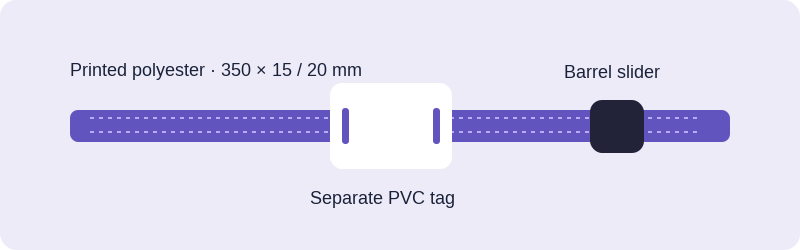
Product detail: printed fabric, separate tag and closure
What to Check Before Ordering RFID Wristbands
Once the technology family has been identified, the next step is to define the actual wristband specification.
A useful procurement process should cover the reader, chip, data requirements, wristband construction and sample testing.
Reader Frequency and Protocol
Start by asking the system provider for the technical specifications of the existing readers.
Confirm:
- Supported frequency.
- Supported communication protocols.
- Compatible chip families.
- Reader firmware or configuration requirements.
- Whether the system requires specific credential formats.
Do not rely on a general statement such as “the system supports RFID.” It is not detailed enough to establish compatibility.
If the system uses MIFARE Classic or DESFire credentials, the migration requirements may be different even though both technologies operate at 13.56 MHz.
See Can Existing MIFARE Classic Readers Use DESFire EV3? for a related example of why reader compatibility needs to be checked at the protocol and credential level.
Chip Type and Data Requirements
Confirm what the wristband needs to store or present.
Depending on the application, requirements may include:
- A unique chip identifier.
- A ticket or membership reference.
- NDEF data or a URL for NFC interactions.
- Data stored in designated memory areas.
- Authentication or encryption functions.
- A mapping file linking chip identifiers to order records.
Not every application needs data written directly to the chip. Some systems use the chip identifier as a reference and keep the actual ticket or account information in a backend database.
For security-sensitive applications, do not treat a basic chip UID as a secure authentication method by itself. The security level should match the risk of the application and the capabilities of the reader and software.
Wristband Material and Construction
The RFID inlay must work within the finished wristband.
The material, dimensions, antenna placement and closure design can all affect the final product.
For example, a multi-day festival may prioritize comfortable fabric construction and a closure suitable for extended wear. A short-term event may prefer a disposable format that is quick to issue.
BandWove’s available formats include printed fabric RFID wristbands, woven RFID wristbands, elastic NFC wristbands and other custom RFID wristband formats.
The best choice depends on the event duration, wearing conditions, artwork requirements and the reader system.
Encoding and Data Management
If wristbands need to be encoded before delivery, clarify who is responsible for preparing the data and performing the encoding.
Questions to resolve include:
- Who supplies the encoding data?
- Which data fields need to be written?
- Does the customer need a chip ID mapping file?
- How will the encoded wristbands be associated with tickets or user accounts?
- How will errors or duplicate records be handled?
- Are there security requirements for transferring sensitive data?
For projects involving secure credentials, encryption keys and sensitive configuration data should be handled through an appropriate secure process rather than shared in an ordinary artwork or order file.
Sample Testing and Compatibility
A sample should be tested with the actual reader and software configuration before mass production.
A useful test should cover:
- Whether the reader recognizes the wristband consistently.
- Whether the correct chip identifier or data is returned.
- Whether the wristband works in its final wearable construction.
- Whether the reading position and distance are suitable for the intended gate.
- Whether the system can process the required ticket or access status.
- Whether the wristband performs reliably across multiple samples.
- Whether the encoding and ID mapping records are correct.
For NFC projects, test with the target smartphone models if mobile interaction is required.
For UHF projects, test the final antenna design and reading zone with the actual portal configuration.
Field scenario: sample scan before the order
At a venue with an existing reader, present the finished sample in the same position a guest would wear it. Record separately whether the reader detected the tag, the software received the expected identifier, and the platform accepted the credential. For a phone-link project, the last step is opening the intended page instead.
Common RFID Wristband Compatibility Problems
Several issues can appear during procurement or deployment.
The wristband and reader operate at different frequencies.
A 125 kHz credential cannot be read by a standard 13.56 MHz NFC reader. The frequency and supported technology must match.
The frequency matches, but the chip protocol does not.
Two credentials can operate at 13.56 MHz and still be incompatible. Confirm the exact chip family and supported protocol.
The chip is recognized, but the ticket is rejected.
This may be a software or data issue rather than a radio-frequency problem. The credential may not be registered, activated or associated with the correct ticket record.
The wristband works outside the gate but fails during actual use.
Antenna orientation, reader configuration, wristband position, interference or the final product construction may affect reading performance.
If a wristband stops working during an event, see RFID Wristband Not Working at an Event? Where to Check First for a practical troubleshooting process.
Frequently Asked Questions
What is the difference between LF, HF and UHF RFID?
LF, HF and UHF refer to different RFID frequency groups. LF commonly operates at 125 or 134.2 kHz, HF commonly operates at 13.56 MHz, and UHF systems operate in regional bands within the wider UHF spectrum. They differ in communication behaviour, reading distance, standards and typical applications.
Can a 125 kHz RFID wristband be read by a smartphone?
No. Standard smartphone NFC hardware operates at 13.56 MHz and cannot directly read a 125 kHz LF RFID wristband.
Are all 13.56 MHz RFID wristbands NFC-compatible?
No. Several HF RFID technologies operate at 13.56 MHz, but not all use the same protocols or support the same smartphone interactions. Confirm the exact chip type and NFC compatibility before ordering.
Is UHF RFID better than NFC for events?
Not necessarily. UHF is useful for applications that require longer-range or multi-tag identification. NFC is designed for short-range tap interactions. The right choice depends on the event workflow, reader infrastructure and intended user experience.
Can an RFID wristband support cashless payments?
Yes, when it is part of a compatible cashless system. The wristband needs an appropriate credential, reader, backend account or balance management and payment integration. A standard RFID wristband does not automatically provide payment functionality.
Can I replace the chip in an existing RFID wristband design?
Possibly, but the antenna, chip dimensions, communication protocol and reader compatibility must be checked. A change in chip technology may require a different inlay or system configuration.
Can I identify RFID frequency from wristband color?
No. Color and artwork do not identify the radio technology. Obtain the documented chip or inlay specification and reader requirements.
Will an LF reader also read HF wristbands?
A reader must explicitly support the required technology. An LF-only reader does not become an HF reader through software enrollment.
Do UHF configurations need to match the operating region?
Yes. Confirm the reader’s configured band and the inlay’s intended region. Do not select a UHF assembly from the chip name alone.
Can two wristbands at the same frequency require different readers?
Yes. Protocols, commands and credential applications can differ within a frequency group. Check the exact supported technology and provisioning.
Finding the Right RFID Wristband Solution for Your Event
Choosing an RFID wristband is not only a product decision. It is a system decision that connects the credential, reader, software and event workflow.
Before confirming an order, identify the existing reader technology, define the required functions and test a sample using the actual system. This helps reduce compatibility issues and makes the final wristband specification easier to verify.
BandWove offers custom wristband formats for event and venue applications, including fabric, woven, elastic, silicone and disposable RFID/NFC options.
If you are planning a festival, concert, exhibition or venue project, share the following details when discussing your requirements:
- Event type and expected order quantity.
- Existing reader or ticketing system model.
- Required frequency, chip type or protocol, if already specified.
- Whether the wristband needs NFC phone interaction, access control or cashless functionality.
- Preferred wristband material, closure and artwork.
- Any encoding or data-matching requirements.
If the chip specification is not yet clear, provide the reader model and system requirements first. The appropriate wristband configuration can then be evaluated before production.
Contact BandWove to discuss a custom RFID wristband solution for your event.