
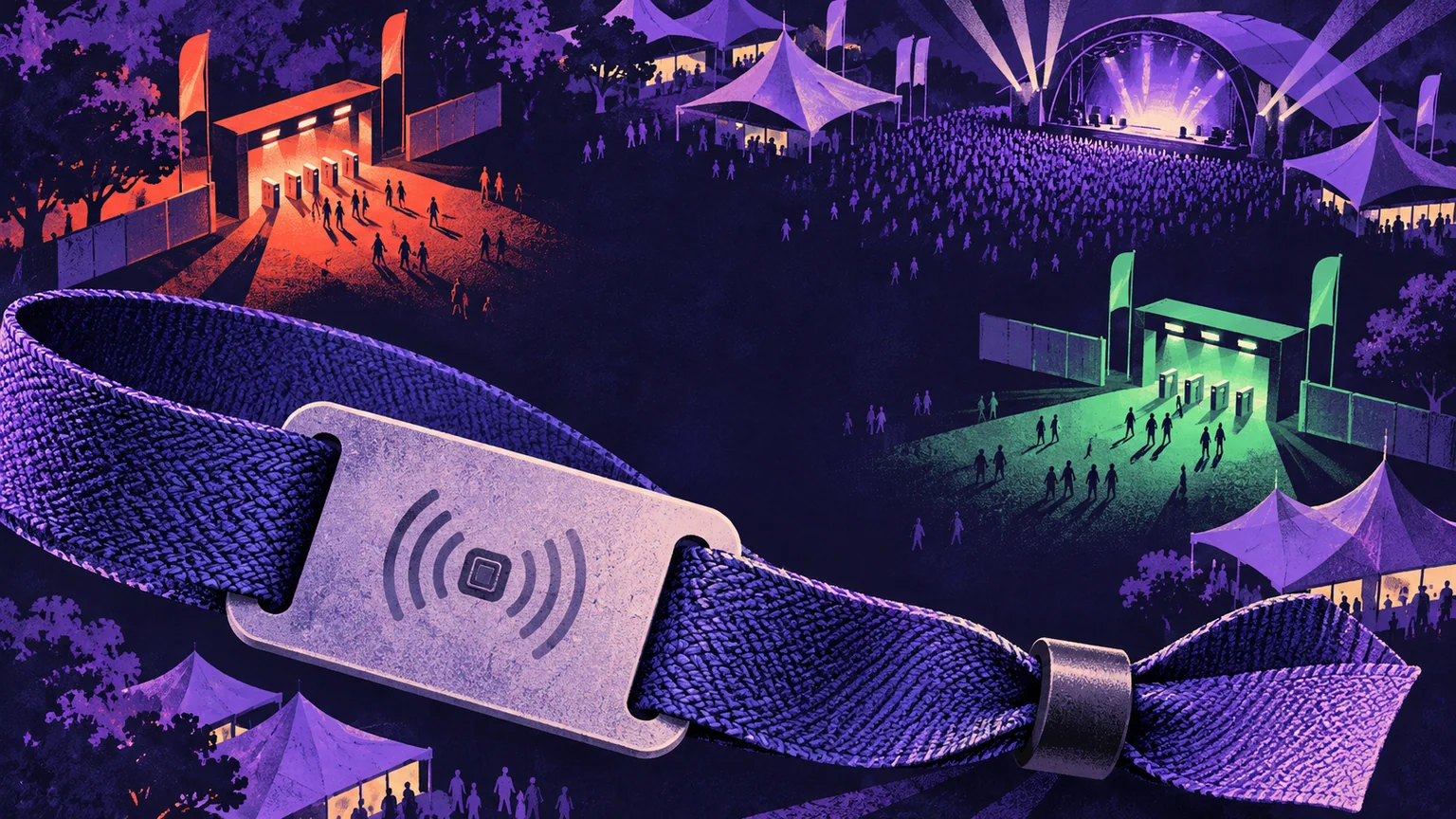
How a wristband becomes a location record
A passive RFID chip gets power from a compatible reader’s radio field. When the reader detects the tag, it can retrieve information such as an identifier. Some chips also have memory for other data. For example, NXP’s NTAG21x chips have a manufacturer-programmed identifier and separate memory that can hold content such as a web link. That describes one chip family. The event decides how to use the information from its own credentials.
The reader gives a detection its location. The event software can associate that reader with a named gate, store a timestamp and look up the credential in its ticketing records. If the credential has been assigned to a named attendee, the software can connect the scan to that record. Here’s what each part of the system contributes.
| Part of the system | What it can contribute | Question to ask |
|---|---|---|
| Wristband | A credential ID or other data available to the reader | Which identifier does this deployment use? |
| Reader | The point or zone where the band was detected | Where are readers installed, and what areas do they cover? |
| Event software | A timestamp, a result such as an accepted scan, and a history if the software stores it | Which detections become records, and how long are they kept? |
| Ticketing or account record | An attendee or order linked to that credential, if the event makes the link | Who can link the records or receive the linked information? |
The identifier matters even if it looks like a random string. An ID that appears on two records can connect those records to each other. An attendee’s name can remain entirely in the ticketing system while the event still knows whose band was read. If you’re new to the radio side, how RFID wristbands work explains what happens during a read.
What a scan history can tell you
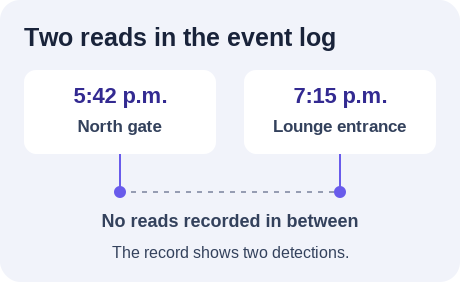
Imagine an event records a band at the north gate at 5:42 p.m. and at a lounge entrance at 7:15 p.m. The entries can establish two detections if the reader locations and timestamps are correct. A linked account can tell staff who was assigned that band.
The time between the two reads is a gap in the record. Those entries cannot show the path between the north gate and the lounge, who the wearer met, or how long they stayed at the lounge. If there is also a recorded exit, the event may be able to estimate time spent in the area. The evidence still comes from the points at which the band was detected.
That distinction also matters when there is no scan. An attendee could have walked through an area that had no suitable reader, or a reader might have missed the band. A blank in the log alone tells you little about where someone was.
How to read the details behind a scan
A scanner can detect a band, the access system can decide whether to admit it, and a reporting tool can later count it. Those are three different moments. If a report shows three reads, ask whether it counts every time the reader saw the band, every time the software made an access decision, or every completed admission. Someone holding their wrist near the reader while an attendant checks the screen can produce repeated detections in a system that records them. Before treating three rows as three visits, check how the report groups them.
Here’s an illustrative record for one credential. The location labels are made up, and the fields depend on the system.
| What the record says | What you can reasonably infer | What to check before drawing a stronger conclusion |
|---|---|---|
| 5:42 p.m., north gate, access accepted | The system accepted that credential at the north gate | If you need to establish that someone actually passed through, check what the event counts as a completed entry |
| 7:15 p.m., lounge entrance, band detected | The reader picked up the credential in its read area | Confirm whether the device was recording arrivals, departures, or either |
| 7:16 p.m., lounge entrance, band detected again | There was another recorded detection at the same point | Check whether this was a new visit or repeated detection during the same encounter |
A reader’s name also has a shelf life. A handheld unit labeled “North Gate” in the software might be moved to a different entrance during the evening. Its label can still appear on reports unless staff record the move and update the assignment. If you’re auditing an event, ask whether the location was taken from a fixed installation or from the device’s assignment at the time of the read. GS1’s event-data guidelines illustrate the distinction between the point where something was observed and an estimate of where it is afterward. That guide describes a data model, not the software used by any of the festivals in this article.
Does the wristband have to touch a scanner?
No. Some systems are set up for a deliberate tap. Other deployments can read a passive tag at a distance when the chip, antenna and reader are suited to the job. The GS1 System Architecture describes passive UHF systems in which a reader supplies the energy to the tag over radio. A tag can be detected inside that system’s read zone without anyone touching it to a reader. That does not tell you the range of the wristband at your festival.
Ask whether the organizer only scans bands where people stop and present them, or also reads them as people pass through a zone. The answer gives you a better idea of what the event could observe than the word “RFID” on the ticket.
How reader coverage changes the answer
Consider a festival with a staffed reader at each public gate and no readers beside the stages. The event might be able to reconstruct the times when a credential was presented at the gates. It would have no stage-by-stage route from those readers alone. Add readers at a camping gate and a lounge entrance, and the event gains observations at those points. Add a system designed to detect bands as they pass through an area, and an attendee may no longer need to stop for a deliberate tap at each point.
The number of readers is only part of the answer. For example, a reader at a doorway might cover the approach as well as the threshold. A detection shows the credential was within the area it could read. Whether it shows someone crossed, and in which direction, depends on how that entrance is designed and what the software records. An organizer who wants to measure dwell time needs a way to identify both arrival and departure, check for missing events, and decide how to handle repeats. With arrival scans alone, the report can count arrivals under a stated definition. Dwell time would be an estimate built on additional assumptions.
Ask about the locations the organizer actually monitors. “At our entrances” gives a more useful answer if it specifies whether that means the venue perimeter, each room, sponsor booths, or all three.
What SXSW and Disney say about detection
SXSW. Its RFID, QR Code & Lead Retrieval Policy says an RFID scan can identify where the attendee was scanned at an SXSW event. It also describes circumstances in which certain registration information may be shared with a sponsor after a scan at a sponsored event. The policy covers RFID wristbands and badge QR codes. It describes consent for badge QR scanning specifically, so check the rule that applies to the credential being presented.
Disney. Its RF device privacy FAQ describes MagicBand, MagicBand+ and DisneyBand+ products that contain a transmitter in addition to a high-frequency RF device. Disney says those wearables can be detected by long-range sensors at select locations. It also says its RF devices do not provide continuous GPS location signals and describes a device code that links to a database. That is a useful example of how a wearable can support more than a tap at an entrance. The hardware and coverage described in the FAQ are specific to Disney’s deployment.
These examples give you two concrete things to look for in a policy. The first is where the band can be detected. The second is what the event can do with the record. A policy might be clear about who receives data and say little about how many points can read a band. If coverage is what concerns you, ask the event directly.
How a credential ID becomes linked to a person
Picture a box office that scans a new band when it hands it over and records the assignment under an order. The gate device can then read the same identifier and log an entry against it. An analyst with access to both datasets might connect the timestamp and gate to the order. If one person bought several passes, that order record may identify the buyer even when the organizer cannot tell from it which guest wore each band. Individual registration would change what the data can establish.
A replacement creates another detail to check. If the box office keeps a record linking the old and new credentials to the same attendee, someone with permission to use that record may be able to see scans from both bands in one history. If the link is unavailable to a particular team, that team may see two separate identifiers. Ask about who can make the connection, alongside what each report happens to display.
An organizer may also make a summary report that shows only totals by entrance and time. A count for each 15-minute interval may be sufficient to plan staffing. The existence of a totals-only report doesn’t tell you whether the organizer still has the underlying scan log. If that distinction matters to you, ask what is collected, what is retained, and which version is shared.
What to check before wearing a festival RFID wristband
Look for the current event’s wristband terms and privacy notice. Search for “RFID,” “credential,” “scan,” “location,” and “sponsor.” If the notice has a contact for privacy questions, ask about the parts that affect your decision.
- Where is it read? Ask about gates, internal zones, sponsor activations and any reader areas that don’t require a tap.
- What does a scan get linked to? Find out whether it is associated with a name, an order, a ticket type, a payment account or a separate profile.
- Who gets the data? Ask which event staff, platforms or sponsors can receive scan information and whether sponsor interactions have their own terms.
- How long are records kept? Ask about scan logs as well as account data. Check which options the organizer actually offers if you want to limit optional sharing or make a privacy request.
If the wristband is also used for purchases, check the cashless payment terms separately. An access log and a purchase record can involve different systems and policies. The guide to cashless festival wristbands explains that workflow.
For event teams, start with a map of readers and a short list of the data each use requires. A gate operator checking admission, a finance team reconciling a sale and a sponsor collecting leads have different jobs. Document what each sees and which platform holds the record before writing the attendee notice. That gives the team a way to answer specific questions about coverage, access and retention.
A practical review for event organizers
Choose one intended use, such as admitting Saturday ticket holders at the north gate. Ask your ticketing lead to demonstrate the steps from band assignment to the report that supervisors actually use. Repeat for any other team receiving records. A short test with an authorized sample credential makes it easier to compare the written policy with the system’s behavior.
- Walk the reader locations. Record the gates, internal checkpoints and sponsor areas that can detect the credential. Note any portable units and how moves are recorded.
- Follow a test credential. Inspect the records for one accepted scan, one rejected scan and one repeated presentation. Check which timestamps, locations and outcomes are retained.
- Review who receives which fields. Check what a gate supervisor sees, what a report export contains, and what a sponsor receives if their use is enabled. Confirm the record can serve each job with the fields assigned to that role.
- Check the end of the event. Ask who can export or retain the information and how long raw logs, exports and summary reports are kept. Identify who answers requests if an attendee has a question later.
Run a similar test whenever readers move to new areas or a partner starts receiving a new report. The privacy notice should describe what the event actually does, including how attendees can find out more about optional uses.
Frequently asked questions
Can my phone see the event’s scan history?
A phone reading the tag does not by itself give you access to the event’s logs. A compatible phone may read content made available on some NFC tags, such as a web link. The event’s scan history lives in its own software when it is recorded there. See which RFID wristbands a phone can read for examples.
Can a festival see where I went after I left?
An ordinary passive wristband on its own cannot report your journey home. An existing scan history can still show where and when the band was detected while the event had readers in range. For any separate tracking through an event app, check the app’s permissions and privacy terms.
Does removing the wristband delete earlier scans?
No. Taking off the band does not erase records the event already stored. Check the organizer’s policy for retention and requests about your data. If you still need the band for entry, follow the event’s instructions before removing it.
Does a passive festival wristband contain GPS?
A normal passive RFID wristband does not determine or broadcast a GPS position. It communicates when a compatible reader powers it within range.
Does a passive wristband need a battery?
No. A passive tag draws energy from the reader’s field. Separate active wearable systems can use batteries and need their own specifications.
Can a wristband record an entry time?
A reader and event platform can log when they detect or accept its credential. That record is different from continuous location tracking.
Does turning off phone NFC stop event reader scans?
No. The wristband and phone are separate devices. A venue reader can still interact with a compatible wristband.
Can a printed wristband number identify its wearer?
It can be linked to a person through registration records. The printed number alone does not establish who is wearing the band.
What should I check in an event’s privacy notice?
Look for what scans are recorded, why they are used, who receives them and the organizer’s retention and contact information.
Can a wristband show my location without any reader nearby?
An ordinary passive tag cannot report a location on its own. Any location estimate would require other equipment or separate application data.