
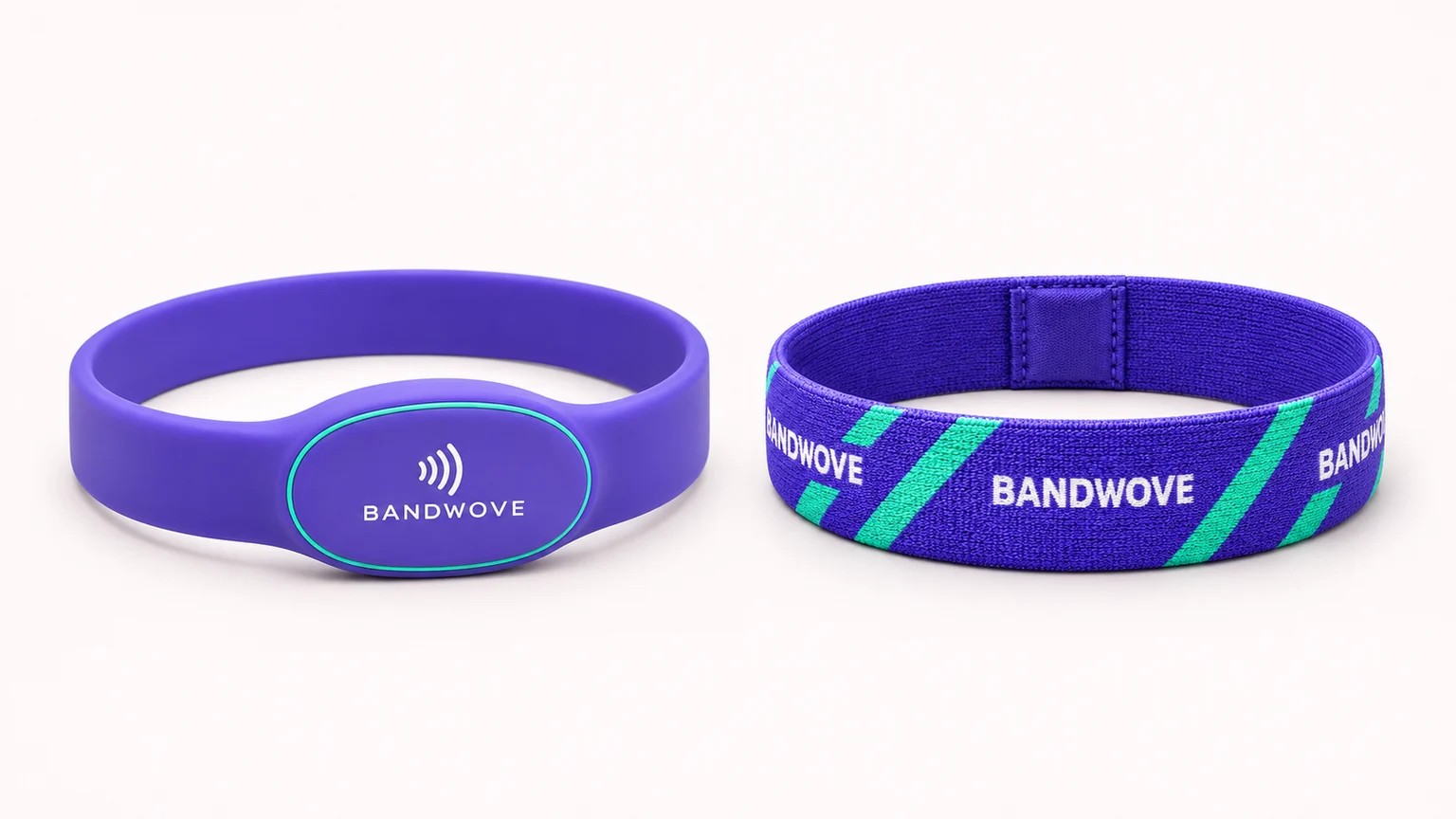
Fit, artwork and tag construction at a glance
| Buying decision | Printed elastic NFC | Molded silicone RFID |
|---|---|---|
| Fit | Soft stretch loop with a join and an internal pocket | Molded closed loop. Oval has a wider contactless face, while Slim has a narrower continuous profile |
| Artwork | Full-color dye sublimation on polyester-spandex. Check the repeat at the join and the logo under stretch | Screen printing for flat artwork. Laser engraving with color infill on Oval, debossing or embossing on Slim |
| Tag location | NFC assembly sits in a sewn pocket inside the band | Oval encloses the assembly in its wider face. Slim embeds it within the continuous band |
| Removal | Slips on and off over the hand | Slips on and off over the hand. Neither closed-loop design uses an adjustable closure |
| Typical fit for the project | Campaign graphics, branded giveaways and phone tap interactions | Venue or locker credentials, repeat wear and projects that need a surface staff can wipe down |
These are BandWove’s current constructions. The elastic product page and silicone product page show the variants and their artwork options.
Measure the hand as well as the wrist
A closed loop has to pass over the widest part of the hand and then settle comfortably on the wrist. A wrist measurement alone misses that first step. For a group order, have representative wearers put the samples on and take them off. Check for pressure around the pocket or wider face, especially if the band will be worn all day. When comparing measurements between suppliers, check whether the figure is the relaxed circumference of the finished loop or the length of a flat strip.
BandWove’s elastic loop is 20 mm wide, with 160, 180 and 200 mm relaxed circumferences. The Silicone Oval is 16 mm wide with circumferences of 180, 195 and 210 mm. Slim is 202 mm in circumference and 12 mm wide. Equal or similar circumferences can still feel different. The stretch of the textile and the thickness of the molded section both affect the pull over the hand. The inner tag pocket adds a firmer section to the elastic loop, so assess the assembled sample.
Artwork on a stretch loop versus molded silicone
With printed elastic, a repeat or gradient can run around the loop. Give any essential lettering enough space away from the joining seam. Review the logo at its finished size and on a wrist. The print may look different when the textile stretches and its structure opens slightly. If the inside carries artwork, check where the pocket covers it and what can be seen when the wearer turns the band.
With molded silicone, the decoration is chosen with the variant. Screen printing places a flat mark on the surface. Laser engraving with infill on Oval creates a recessed, colored mark. On Slim, debossed letters sit below the surface and embossed letters stand above it. Check the narrowest strokes and letter gaps on a physical proof. A logo can work at 16 mm on the oval face but lose detail when fitted to a 12 mm strap. Use the shape and decoration method on the product proof to place the mark.
Where the antenna sits and why it matters
The inner pocket and the molded enclosure position the electronics differently on the wrist. The shape of the band gives people a clue about where to tap, but the antenna’s position and orientation affect how the band couples with the reader. The wider Oval face can be easier to point at a reader consistently. On a Slim loop or a fabric band, a small printed tap cue can help the wearer find the right section.
For a phone interaction, test the encoded link on the phones your audience is likely to use. A suitable NFC chip can carry a web link, but the wrist, antenna geometry and phone position still affect how easily it reads. For a door, locker or admission reader, use the credential type and provisioning instructions specified by the operator. Two wristbands that both say “13.56 MHz” can differ in protocol, data layout and authentication. Test the finished wristband on the intended reader and verify that the system grants the expected access. The RFID chip guide explains what to collect from the operator.
Plan cleaning and reissue before choosing the band
Molded silicone is a useful starting point for a facility that collects and wipes down wristbands between users. Check the approved cleaner, contact time and drying procedure against the decorated surface and electronics enclosure. Test whether the selected branding remains readable after repeated cleaning. With elastic, pay attention to the seam and pocket, where the textile can retain moisture after wiping or washing.
For showers, swimming or frequent wet use, ask what the finished assembly has been evaluated to withstand. The molded body, sealed electronics, inks and joins have different jobs. See the water-resistance guide for the questions to ask about the complete band. When reissuing either format, staff also need a way to revoke the previous assignment and verify the new one.
Sample approval checklist
- Fit: Try the actual circumference on several hands and wrists. Check pressure at the pocket or oval face.
- Artwork: Review the correct decoration method at finished size, including the seam on elastic or the available logo area on silicone.
- Scan: Present the band as it will be worn. Use the real reader or target phones, the intended credential and a sample with the same enclosure and antenna.
- Care: Trial the planned cleaning routine and inspect the decoration, seams and pocket or enclosure afterward.
- Reuse policy: Decide who collects the bands and how credentials are revoked, reassigned and checked. If removal or sharing must be prevented, compare the single-use and reusable constructions.
Frequently asked questions
Which is better for a full-color event design?
Choose printed elastic if the artwork uses gradients, photographic detail or a continuous multicolor repeat. Silicone is a good fit for a defined logo or lettering. The chosen silicone variant determines whether the design is printed, engraved or molded in relief.
Can silicone and elastic wristbands use the same RFID chip?
Sometimes. Start with the chip required by your reader or phone interaction, then check whether it is available in the chosen construction. Even with the same IC, different antennas or enclosures can affect where and how reliably you can scan the wristband.
Can a removable wristband be used for controlled entry?
Yes, when the access system accepts its credential and the event policy allows removable bands. If the band must stay on one guest, choose an appropriate closure and pair it with a re-entry policy. A reusable closed loop can be handed to another person.
Sources & scope
BandWove dimensions and process combinations follow the elastic-pocket, silicone-oval and silicone-slim product profiles. The ID&C elastic smartcard template illustrates seam coverage on a different construction. CEDAGLO shows a sewn RFID module. SAG and ID&C illustrate silicone finishes. NXP documents the IC. No supplier-specific durability, immersion or read-range claim has been transferred.
- ID&C 180 × 20 mm elastic smartcard artwork template
- CEDAGLO RFID elastic wristband construction
- SAG silicone wristband construction and decoration
- ID&C silicone wristband decoration options
- NXP NTAG213, NTAG215 and NTAG216 data sheet
References checked November 6, 2026.