
What a gym wristband does at each reader
At the entrance, the club’s reader identifies the member credential. The access system checks the account and any rules for the site or time of day. At a locker, the lock or locker system checks who can claim or open that compartment. One wristband can serve both points when the devices read a compatible credential and their systems have the correct assignment.
Glasgow Club describes this in its venue access guidance. At locations with suitable equipment, the same silicone membership wristband can be used at automatic gates and RFID lockers. The club also explains that some venues accept a wristband or other token for a locker even when it is separate from a membership account. The service the wristband provides depends on what the venue has configured.
Match the wristband to installed equipment
Record the door readers and locker locks separately. A member card that works at both is a useful reference for the club’s integrator. Ask which chip or credential format each device accepts and who enrolls it. Two readers can work at 13.56 MHz and use different chip families or encoded applications. The correct frequency is one of the details needed to specify a working band.
| Checkpoint | Information to collect | What the configured sample should do |
|---|---|---|
| Reception enrollment | Membership platform, existing credential type and who enrolls replacements | Associate the new band with the correct member or guest record |
| Entrance turnstile or door | Reader model, required credential format and site or schedule rules | Admit the intended active member and apply the expected restrictions to an expired pass |
| Locker | Lock model, locker mode and how updates or releases are handled | Claim or open the intended compartment and release it at the end of use where applicable |
| Additional site | Reader and lock models at that location and any membership restrictions | Work at the sites included in the member’s plan |
Ask for the configuration of the working credential when more than one technology is installed. A club that uses a particular format at the entrance and a different format at the lockers may need separate credentials or an integration approved by the system operator. An RFID wristband intended for one reader should be tested against the other points before the full order. The RFID chip selection guide explains the details to request from the integrator.
Choose the locker assignment first
Shared day-use lockers. The member chooses an available locker or receives one for the visit, depending on the club’s system. A full trial covers claiming it, reopening it during the visit and releasing it. Check that the next member can claim the compartment once the session ends. If the club has a use limit or a closing-time routine, include it in the staff briefing.
Dedicated member lockers. Each compartment stays assigned to an identified member or plan for an agreed period. Reception needs to know how to transfer a member to a different compartment or end an assignment. Where a member changes their wristband mid-term, the replacement should open the same assigned locker once the locker system has applied the change.
Visitor or trial passes. Some clubs give guests a loaner solely for a locker. Others enroll one wristband for the visit and associate it with both guest entry and the locker. Decide when the guest credential expires and whether staff collect the band. If the loaner is returned while a locker is still assigned, the desk needs a way to release the previous session before issuing that band again.
A networked locker system can receive changes through the equipment that manages it. With a standalone or intermittently connected lock, ask the installer how permission updates and abandoned assignments are handled at the physical locker. For loss or reassignment, verify the outcome at the locker door as well as at reception.
Fit and finish for repeated gym use
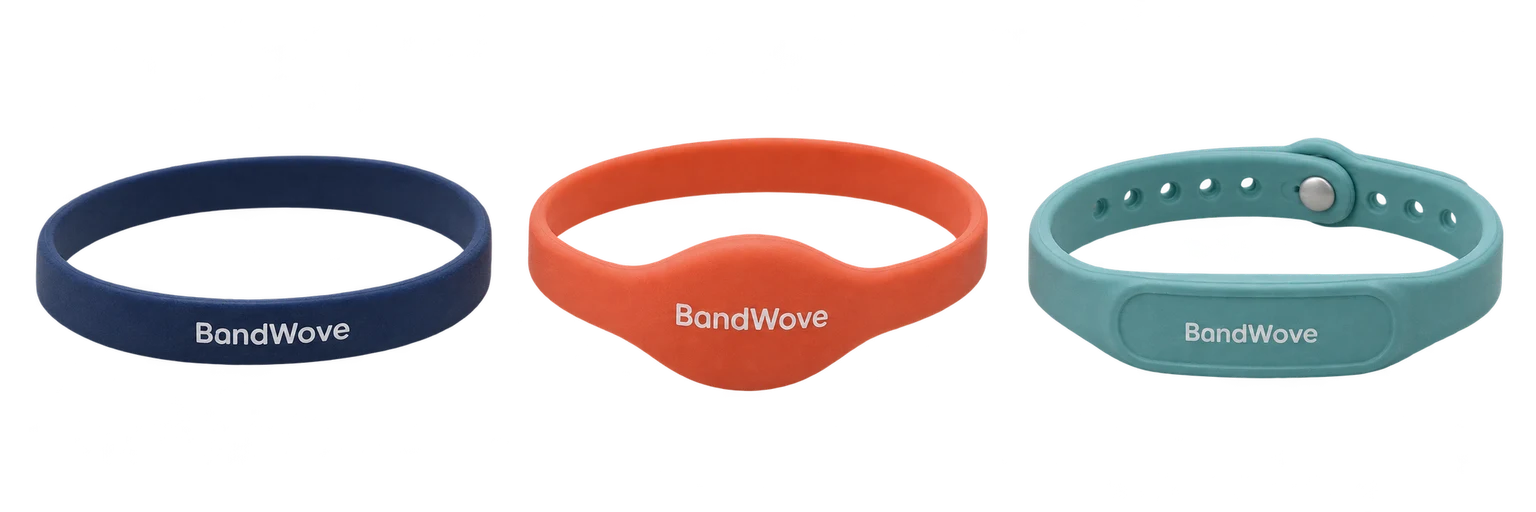
A closed silicone loop suits an issued band that members remove after a workout and wear on a return visit. A good fit clears the hand and keeps the readable area in a position that is easy to bring to a door or cabinet reader. Meet with a representative range of wearers before assigning membership sizes. Plan sizes for loaners separately if front-desk staff will share that stock across visitors.
BandWove’s Oval has an integrated RFID housing and comes in 180, 195 and 210 mm loop circumferences. Slim is a narrower continuous loop with an embedded chip and its own fit and marking options. The face of an Oval housing and the width of a Slim band offer different space for logos or identifiers. Compare the artwork on the molded sample and make sure staff can read any serial after normal wear and cleaning.
If members wear the band in showers or a pool, evaluate the finished band under those conditions and confirm its reader performance when worn wet. When only some users visit those facilities, note the exposed group and its intended cleaning routine in the brief.
Enroll, replace and reissue bands
Decide which records staff will use at reception. The membership or visitor ID, printed serial and chip identifier can all be useful, each for a different lookup. A visible serial helps the desk locate a band in the issue register. The guide to wristband serial numbers and chip UIDs shows how to map them without losing leading zeros. Use the club’s established account process to record who holds a band.
When a member reports a lost wristband, identify the account and use the club’s authorized procedure to deactivate that credential. Record any locker still assigned to it. Coordinate the assignment change or release with the locker operator and follow the club’s procedure for access to belongings. Enroll the new wristband and exercise the actual door and locker before completing the replacement. A standalone lock can need its own update process.
For loaners, a daily count should reflect the largest number issued at once and the bands unavailable during cleaning or replacement. Member bands issued for personal use follow the member rollout and its size split. Those two quantities serve different programs, even when both use the same printed design.
What to test before approving the order
Use a sample in the intended size, material and credential configuration. Have the club’s reception team run the issue process and the operator use the normal membership and locker controls.
| Test | Expected result |
|---|---|
| Enroll and check in | The active account opens the correct entrance and the visit appears in the club’s record |
| Try a time or location restriction | The system applies the restrictions assigned to that test member |
| Use the designated locker mode | The member can use the assigned compartment, or claim and release a shared one |
| Replace a lost test band | The old credential is inactive at the equipment that used it, and the new one has the intended member rights |
| Read after normal wear and cleaning | The reader recognizes the fitted band, and the marking used at reception remains legible |
Write down the reader and lock models used in the trial and the process that enrolled the sample. If the club rolls out several branches, confirm the equipment at each branch before applying the same specification.
Frequently asked questions
Can one band replace both a membership card and a locker fob?
Yes, if both systems accept the chosen credential and have a way to associate it with the member or locker assignment. Share the current card and fob types with the integrator, then try the configured band at both points.
What is the difference between a day-use locker and an assigned locker?
A day-use locker is claimed or assigned for a visit and released afterward. A dedicated locker stays assigned for the agreed term. The club’s equipment and enrollment process should support the intended mode.
Will a lost wristband stop opening the locker when reception deactivates it?
That depends on how the locker receives changes. Ask the operator how the update reaches the lock and how the original assignment is released. Confirm the result at the assigned locker during a replacement trial.
What should a gym provide for a wristband quote?
Provide the models of the membership readers and locker locks, the credential or encoding requirements, sizes and quantities by wearer group, logo or numbering, intended use and arrival date. For multi-site orders, include the equipment used at each site.
Can a wristband replace a magnetic-stripe membership card?
A magnetic-stripe reader cannot directly read a contactless band. Check whether the club has compatible contactless hardware or needs a reader change.
Why might a gym wristband open the gate but not a locker?
The locker may use a different credential or assignment process. Test the membership and locker systems separately, including enrollment and release.
Can a gym use the same band across several branches?
Yes, where each branch’s equipment and membership platform support the credential. Include every reader and lock family in the pilot.
Does a successful scan mean the membership is active?
No. Detection obtains a credential response; the membership platform still needs to confirm the member’s current rights and permitted times.
Can a returned gym wristband be given to another member?
Use a suitable cleaning and inspection process, then release old membership and locker associations before issuing the band to the next member.
Can a membership wristband also open training information on a phone?
A supported NFC link can open a training or class page. That content interaction is separate from the membership credential used at the entrance.
Sources
References checked November 21, 2026.