
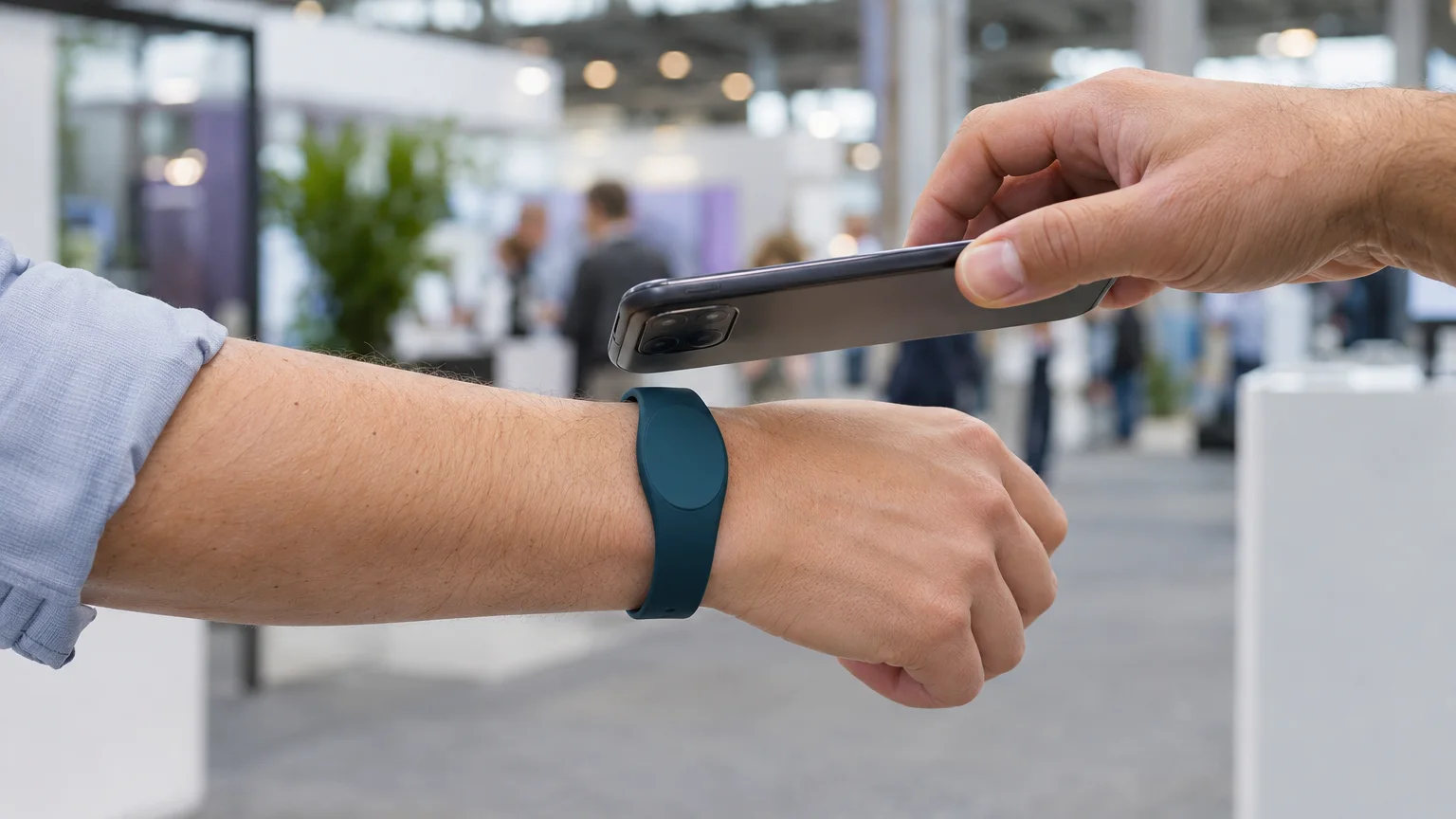
The choice starts with what a visitor’s phone should receive. A festival can put a whole weekend’s schedule behind a short link. A workshop that needs its instructions available offline may want enough memory for the text itself.
Four NFC wristband encoding examples
We encoded four sample records for common event uses. Input is the size of the original URL, file, or text. NDEF message is its size in NFC Data Exchange Format, which identifies the content as a link, contact file, or text. Bytes on tag counts the stored message, its Type 2 wrapper, and the terminator. Compare it with the available space in the tag’s NDEF area.
| What the wristband stores | Input | NDEF message | Bytes on tag | Smallest chip that fits |
|---|---|---|---|---|
| Festival schedule URL | 28 B | 25 B | 28 B | NTAG213 |
| Exhibitor contact page URL | 35 B | 32 B | 35 B | NTAG213 |
| The same exhibitor’s contact details as a vCard | 207 B | 220 B | 223 B | NTAG215 |
| Plain-text workshop guide for offline use | 575 B | 585 B | 590 B | NTAG216 |
Source: BandWove NFC wristband encoding examples, v1.0, November 24, 2026. Each row is a software calculation for one specific input. Download the inputs and byte counts (CSV).
Can an NTAG213 handle a three-day festival schedule?
Suppose you order 500 wristbands for a festival with three stages. Guests need the full lineup, but the only thing written to each band is the address of the schedule page. In this example, that address is https://example.org/schedule.
The URL starts out at 28 bytes. An NFC URI record represents the eight characters in https:// with a one-byte prefix code. The domain and path take another 20 bytes. Four bytes for the NDEF record bring the message to 25 bytes. The Type 2 wrapper and terminator add three more, so the stored record takes 28 bytes.
If Saturday’s headliner moves to another stage, update the page at the same address. All 500 bands still point to the current lineup. Guests need a connection to load the updated page. The final URL, including any tracking parameters, determines the size of the record you’ll write.
When does an exhibitor wristband need NTAG215?
Alex, our example exhibitor, can share his details using the link https://example.org/exhibitors/alex. That record takes 35 bytes. He can change his phone number on the page even after the show ends.
If visitors need his details while the exhibition hall’s Wi-Fi is congested, Alex can store a contact file directly on the wristband. Our vCard takes 207 bytes before encoding and 223 bytes on the band. That fits the NTAG215. At sample approval, have someone tap the band with a phone your visitors use and try saving the contact. Reading the file and importing it into an address book are separate parts of the visitor experience.
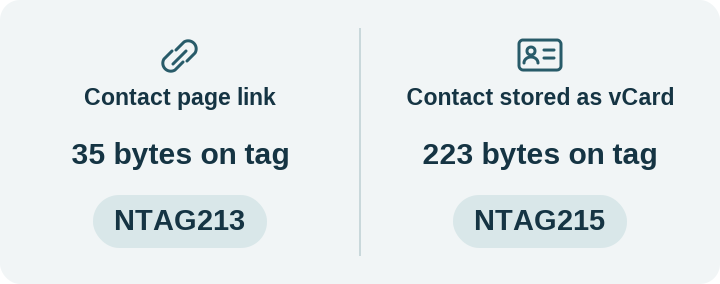
For an order covering 80 exhibitors, size the chip using the largest encoded contact record in the batch. The first exhibitor on your list may have a short name and a single email address. Another may include a bilingual job title and two URLs. Count the UTF-8 bytes in the final files, especially for names with accented characters or text in multiple languages.
When is it worth moving from NTAG215 to NTAG216?
Our weekend workshop guide includes badge pickup, opening times, room assignments, and instructions for collecting finished work. Encoded as a single English text record, the 575-byte guide occupies 590 bytes. It exceeds the NTAG215’s default NDEF data area and fits on the NTAG216. Visitors can retrieve the stored text with a compatible NFC reader or app even when the venue has no internet connection.
The trade-off shows up when a room changes. A link lets the organizer update directions in one place. A guide stored directly on the wristband needs to be rewritten on each affected band. For a workshop with a fixed program and poor reception, that may be a reasonable choice. For a festival with last-minute lineup changes, a link is easier to maintain.

Why does the NTAG215 datasheet list both 504 and 496 bytes?
NXP publishes two figures that matter here. User memory is the chip’s user read/write area. The default NDEF data area is the space its factory-set Capability Container declares for storing NDEF-formatted data.
| Chip | User memory | Default NDEF data area |
|---|---|---|
| NTAG213 | 144 bytes | 144 bytes |
| NTAG215 | 504 bytes | 496 bytes |
| NTAG216 | 888 bytes | 872 bytes |
The factory NTAG213 layout also uses five bytes for a Lock Control TLV inside its 144-byte area. The examples count the record and its storage wrapper, so leave those five bytes available when checking an NTAG213 near its limit. See our NTAG213 URL length guide for a worked example.
For example, a 500-byte plain-text file already exceeds the NTAG215’s default 496-byte area before you add the record header and storage overhead. If a file is close to the limit, encode the final version and compare it with the space available on the intended tag. NXP NTAG213/215/216 datasheet, section 8.5.4–8.5.6, Tables 4–7.
What to send with a custom wristband inquiry
For a custom wristband quote, share the quantity, what should happen when someone taps the band, and a copy of the final URL or file. If every band carries different content, include the number of unique records and the largest example. A festival buyer could send this:
We need 500 custom wristbands, all encoded with the same festival schedule URL. A guest should be able to tap the band and open the schedule on their phone. We’ll update the lineup at the same address. Please size the chip using the attached final URL and use that link on the sample band.
If the band also needs to open a gate or work at a payment terminal, include the credential model your system provider specifies. A successful phone tap verifies the schedule link. Check admission and payment separately against the venue’s equipment. For more on matching a chip to the installed system, see our RFID wristband chip selection guide.
How to reproduce the byte counts
Each example uses UTF-8 and a single NDEF record without a record ID. The URLs use NFC URI prefix compression. The vCard uses the MIME type text/vcard and CRLF line endings. The offline guide uses an NFC text record with the language code en. The on-tag totals include the Type 2 NDEF Message TLV (the field that identifies the message and gives its length) and a one-byte terminator. Each example leaves room for that terminator.
The CSV includes the exact input and encoded bytes in hexadecimal. To reproduce it, save the Python script in an empty folder and run python3 reproduce.py. It writes the CSV alongside the script. Example data (CSV) · Reproduction script (Python) · NFC Forum specifications.